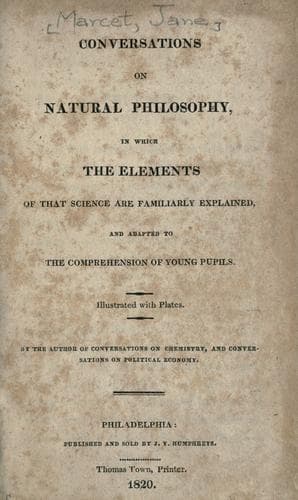
Conversations on Natural Philosophy, in which the Elements of that Science are Familiarly ExplainedMarcet, Mrs. (Jane Haldimand)
Science
Conversations on Natural Philosophy, in which the Elements of that Science are Familiarly Explained
Marcet, Mrs. (Jane Haldimand)
Physics
_Mrs. B._ Your observation is perfectly just: the difference of gravity
in bodies situated at the poles, and at the equator, cannot be
ascertained by weighing them; a pendulum was therefore used for that
purpose.
_Caroline._ What, the pendulum of a clock? how could that answer the
purpose?
_Mrs. B._ A pendulum consists of a line, or rod, to one end of which a
weight is attached, and by the other end it is suspended to a fixed
point, about which it is made to vibrate. When not in motion, a
pendulum, obeying the general law of attraction, hangs like a plumb
line, perpendicular to the surface of the earth, but if you raise the
pendulum, gravity will bring it back to its perpendicular position. It
will, however, not remain stationary there, for the momentum it has
acquired during its descent, will impel it onwards, and if unobstructed,
it will rise on the opposite side to an equal height; from thence it is
brought back by gravity, and is again forced upwards, by the impulse of
its momentum.
_Caroline._ If so, the motion of a pendulum would be perpetual, and I
thought you said, that there was no perpetual motion on the earth.
_Mrs. B._ The motion of a pendulum is opposed by the resistance of the
air in which it vibrates, and by the friction of the part by which it is
suspended: were it possible to remove these obstacles, the motion of a
pendulum would be perpetual, and its vibrations perfectly regular; each
being of equal distance, and performed in equal times.
_Emily._ That is the natural result of the uniformity of the power which
produces these vibrations, for the force of gravity being always the
same, the velocity of the pendulum must consequently be uniform.
_Caroline._ No, Emily, you are mistaken; the force is not every where
the same, and therefore the effect will not be so either. I have
discovered it, Mrs. B.; since the force of gravity is less at the
equator than at the poles, the vibrations of the pendulum will be slower
at the former place than at the latter.
_Mrs. B._ You are perfectly right, Caroline; it was by this means that
the difference of gravity was discovered, and the true figure of the
earth ascertained.
_Emily._ But how do they contrive to regulate their time in the
equatorial and polar regions? for, since in our part of the earth the
pendulum of a clock vibrates exactly once in a second, if it vibrates
faster at the poles, and slower at the equator, the inhabitants must
regulate their clocks in a manner different from us.
Public-domain text, read in full here on John Shaqi.
Reviews
Reviews
No reviews yet
Be the first to share your thoughts on this work.
Elsewhere in the archive
Join the Discussion
Join the discussion
Sign in to leave a comment or review.
Sign InorCreate an account