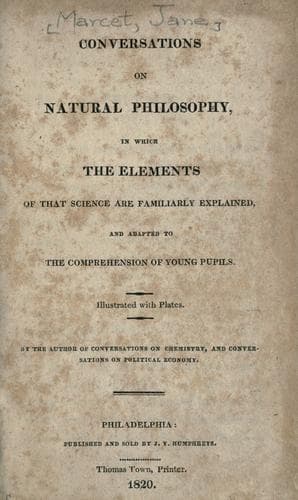
Conversations on Natural Philosophy, in which the Elements of that Science are Familiarly ExplainedMarcet, Mrs. (Jane Haldimand)
Science
Conversations on Natural Philosophy, in which the Elements of that Science are Familiarly Explained
Marcet, Mrs. (Jane Haldimand)
Physics
_Mrs. B._ The only alteration required is to lengthen the pendulum in
one case, and to shorten it in the other; for the velocity of the
vibrations of a pendulum depends on its length; and when it is said that
a pendulum vibrates quicker at the pole than at the equator, it is
supposed to be of the same length. A pendulum which vibrates seconds in
this latitude is about 39-1/7 inches long. In order to vibrate at the
equator in the same space of time, it must be somewhat shorter; and at
the poles, it must be proportionally lengthened.
The vibrations of a pendulum, resemble the descent of a body on an
inclined plane, and are produced by the same cause; now you must
recollect, that the greater the perpendicular height of such a plane, in
proportion to its length, the more rapid will be the descent of the
body; a short pendulum ascends to a greater height than a larger one, in
vibrating a given distance, and of course its descent must be more
rapid.
I shall now, I think, be able to explain to you the cause of the
variation of the seasons, and the difference in the length of the days
and nights in those seasons; both effects resulting from the same cause.
In moving round the sun, the axis of the earth is not perpendicular to
the plane of its orbit. Supposing this round table to represent the
plane of the earth's orbit, and this little globe, the earth; through
this I have passed a wire, representing its axis and poles. In moving
round the table, I do not hold the wire perpendicular to it, but
obliquely.
_Emily._ Yes, I understand, the earth does not go round the sun in an
upright position, its axis is slanting or oblique; and, it of course,
forms an angle with a line drawn perpendicular to the plane of the
earth's orbit.
_Mrs. B._ All the lines, which you learnt in your last lesson, are
delineated on this little globe; you must consider the ecliptic as
representing the plane of the earth's orbit; and the equator, which
crosses the ecliptic in two places, then shows the degree of obliquity
of the axis of the earth; which amounts to 23-1/2 degrees, very nearly.
The points in which the ecliptic intersects the equator, are called the
equinoctial points.
But I believe I shall render the effects of the obliquity of the earth's
axis clearer to you, by the revolution of the little globe round a
candle, which shall represent the sun. (Plate IX. fig. 2.)
As I now hold it, at A, you see it in the situation in which it is in
the midst of summer, or what is called the summer solstice, which is on
the 21st of June.
_Emily._ You hold the wire awry, I suppose, in order to show that the
axis of the earth is not upright?
Public-domain text, read in full here on John Shaqi.
Reviews
Reviews
No reviews yet
Be the first to share your thoughts on this work.
Elsewhere in the archive
Join the Discussion
Join the discussion
Sign in to leave a comment or review.
Sign InorCreate an account