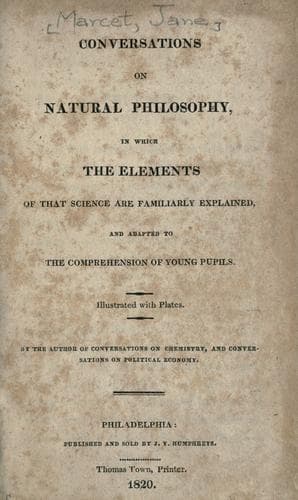
Conversations on Natural Philosophy, in which the Elements of that Science are Familiarly ExplainedMarcet, Mrs. (Jane Haldimand)
Science
Conversations on Natural Philosophy, in which the Elements of that Science are Familiarly Explained
Marcet, Mrs. (Jane Haldimand)
Physics
_Mrs. B._ Yes; in summer, the north pole is inclined towards the sun. In
this season, therefore, the northern hemisphere enjoys much more of his
rays than the southern. The sun, you see, now shines over the whole of
the north frigid zone, and notwithstanding the earth's diurnal
revolution, which I imitate by twirling the ball on the wire, it will
continue to shine upon it as long as it remains in this situation,
whilst the south frigid zone is at the same time completely in darkness.
_Caroline._ That is very strange; I never before heard that there was
constant day or night in any part of the world! How much happier the
inhabitants of the north frigid zone must be than those of the southern;
the first enjoy uninterrupted day, while the last are involved in
perpetual darkness.
_Mrs. B._ You judge with too much precipitation; examine a little
further, and you will find, that the two frigid zones share an equal
fate.
We shall now make the earth set off from its position in the summer
solstice, and carry it round the sun; observe that the pole is always
inclined in the same direction, and points to the same spot in the
heavens. There is a fixed star situated near that spot, which is hence
called the north polar star. Now let us stop the earth at B, and examine
it in its present situation; it has gone through one quarter of its
orbit, and is arrived at that point at which the ecliptic cuts, or
crosses, the equator, and which is called the autumnal equinox.
_Emily._ The sun now shines from one pole to the other, just as it would
constantly do, if the axis of the earth were perpendicular to its orbit.
_Mrs. B._ Because the inclination of the axis is now neither towards the
sun, nor in the contrary direction; at this period of the year, the days
and nights are equal in every part of the earth. But the next step she
takes in her orbit, you see, involves the north pole in darkness, whilst
it illumines that of the south; this change was gradually preparing as I
moved the earth from summer to autumn; the arctic circle, which was at
first entirely illumined, began to have short nights, which increased as
the earth approached the autumnal equinox; and the instant it passed
that point, the long night of the north pole commences, and the south
pole begins to enjoy the light of the sun. We shall now make the earth
proceed in its orbit, and you may observe that as it advances, the days
shorten and the nights lengthen, throughout the northern hemisphere,
until it arrives at the winter solstice, on the 21st of December, when
the north frigid zone is entirely in darkness, and the southern has
uninterrupted daylight.
[Illustration: PLATE X.]
_Caroline._ Then, after all, the sun which I thought so partial, confers
his favours equally on all.
Public-domain text, read in full here on John Shaqi.
Reviews
Reviews
No reviews yet
Be the first to share your thoughts on this work.
Elsewhere in the archive
Join the Discussion
Join the discussion
Sign in to leave a comment or review.
Sign InorCreate an account