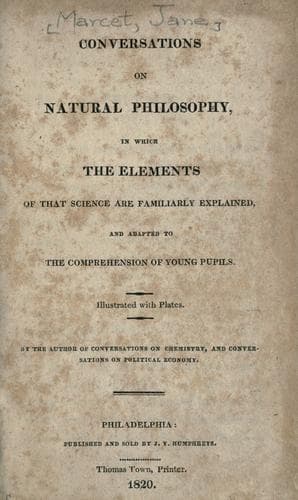
Conversations on Natural Philosophy, in which the Elements of that Science are Familiarly ExplainedMarcet, Mrs. (Jane Haldimand)
Science
Conversations on Natural Philosophy, in which the Elements of that Science are Familiarly Explained
Marcet, Mrs. (Jane Haldimand)
Physics
_Mrs. B._ Not so either: the inhabitants of the torrid zone have much
more heat than we have, as the sun's rays fall perpendicularly twice in
the course of a year, on every place within the tropics, while they
shine more or less obliquely on the rest of the world, and almost
horizontally at the poles; for during their long day of six months, the
sun moves round their horizon without either rising or setting; the only
observable difference, is that it is more elevated by a few degrees at
mid-day, than at midnight.
_Emily._ To a person placed in the temperate zone, in the situation in
which we are in England, the sun will shine neither so obliquely as it
does on the poles, nor vertically as at the equator; but its rays will
fall upon him more obliquely in autumn, and winter, than in summer.
_Caroline._ And therefore, the inhabitants of the temperate zones, will
not have merely one day, and one night, in the year, as happens at the
poles, nor will they have equal days, and equal nights, as at the
equator; but their days and nights will vary in length, at different
times of the year, according as their respective poles incline towards,
or from the sun, and the difference will be greater in proportion to
their distance from the equator.
_Mrs. B._ We shall now follow the earth through the other half of her
orbit, and you will observe, that now exactly the same changes take
place in the southern hemisphere, as those we have just remarked in the
northern. Day commences at the south pole, when night sets in at the
north pole; and in every other part of the southern hemisphere the days
are longer than the nights, while, on the contrary, our nights are
longer than our days. When the earth arrives at the vernal equinox, D,
where the ecliptic again cuts the equator, on the 21st of March, she is
situated, with respect to the sun, exactly in the same position, as in
the autumnal equinox; and the only difference with respect to the
earth, is, that it is now autumn in the southern hemisphere, whilst it
is spring with us.
_Caroline._ Then the days and nights are again every where equal.
_Mrs. B._ Yes, for the half of the globe which is enlightened, extends
exactly from one pole to the other, the sun has just risen to the north
pole, and is just setting to the south pole; but in every other part of
the globe, the day and night is of twelve hours length; hence the word
equinox, which is derived from the Latin, meaning equal night.
As our summer advances, the days lengthen in the northern hemisphere,
and shorten in the southern, till the earth reaches the summer solstice,
when the north frigid zone is entirely illumined, and the southern is in
complete darkness; and we have now brought the earth again to the spot
from whence we first accompanied her.
Public-domain text, read in full here on John Shaqi.
Reviews
Reviews
No reviews yet
Be the first to share your thoughts on this work.
Elsewhere in the archive
Join the Discussion
Join the discussion
Sign in to leave a comment or review.
Sign InorCreate an account