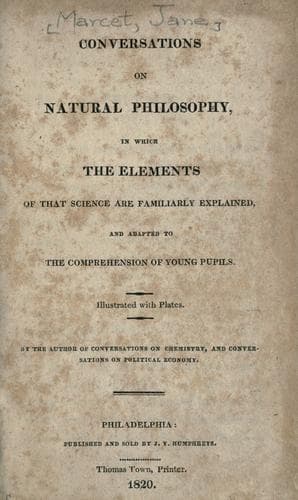
Conversations on Natural Philosophy, in which the Elements of that Science are Familiarly ExplainedMarcet, Mrs. (Jane Haldimand)
Science
Conversations on Natural Philosophy, in which the Elements of that Science are Familiarly Explained
Marcet, Mrs. (Jane Haldimand)
Physics
_Emily._ This is indeed a most satisfactory explanation of the cause of
the different lengths of our days and nights, and of the variation of
the seasons; and the more I learn, the more I admire the simplicity of
means by which such wonderful effects are produced.
_Mrs. B._ I know not which is most worthy of our admiration, the causes,
or the effects of the earth's revolution round the sun. The mind can
find no object of contemplation more sublime, than the course of this
magnificent globe, impelled by the combined powers of projection and
attraction, to roll in one invariable course, around the source of light
and heat: and what can be more delightful than the beneficent effects of
this vivifying power on its attendant planet. It is at once the grand
principle which animates and fecundates nature.
_Emily._ There is one circumstance in which this little ivory globe
appears to me to differ from the earth; it is not quite dark on that
side of it which is turned from the candle, as is the case with the
earth when neither moon nor stars are visible.
_Mrs. B._ This is owing to the light of the candle, being reflected by
the walls of the room, on every part of the globe, consequently that
side of the globe, on which the candle does not directly shine, is not
in total darkness. Now the skies have no walls to reflect the sun's
light on that side of our earth which is in darkness.
_Caroline._ I beg your pardon, Mrs. B., I think that the moon, and
stars, answer the purpose of walls in reflecting the sun's light to us
in the night.
_Mrs. B._ Very well, Caroline; that is to say, the moon and planets;
for the fixed stars, you know, shine by their own light.
_Emily._ You say, that the superior heat of the equatorial parts of the
earth, arises from the rays falling perpendicularly on those regions,
whilst they fall obliquely on these more northern regions; now I do not
understand why perpendicular rays should afford more heat than oblique
rays.
_Caroline._ You need only hold your hand perpendicularly over the
candle, and then hold it sideways obliquely, to be sensible of the
difference.
_Emily._ I do not doubt the fact, but I wish to have it explained.
_Mrs. B._ You are quite right; if Caroline had not been satisfied with
ascertaining the fact, without understanding it, she would not have
brought forward the candle as an illustration; the reason why you feel
so much more heat if you hold your hand perpendicularly over the candle,
than if you hold it sideways, is because a stream of heated vapour
constantly ascends from the candle, or any other burning body, which
being lighter than the air of the room, does not spread laterally but
rises perpendicularly, and this led you to suppose that the rays were
hotter in the latter direction. Had you reflected, you would have
discovered that rays issuing from the candle sideways, are no less
perpendicular to your hand when held opposite to them, than the rays
which ascend when your hand is held over them.
Public-domain text, read in full here on John Shaqi.
Reviews
Reviews
No reviews yet
Be the first to share your thoughts on this work.
Elsewhere in the archive
Join the Discussion
Join the discussion
Sign in to leave a comment or review.
Sign InorCreate an account