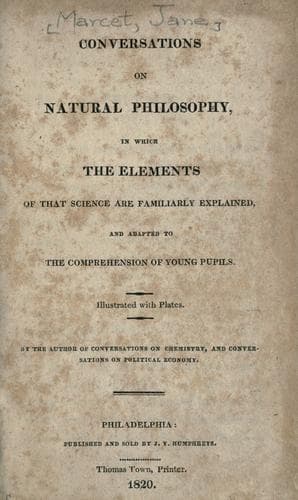
Conversations on Natural Philosophy, in which the Elements of that Science are Familiarly ExplainedMarcet, Mrs. (Jane Haldimand)
Science
Conversations on Natural Philosophy, in which the Elements of that Science are Familiarly Explained
Marcet, Mrs. (Jane Haldimand)
Physics
The reason why the sun's rays afford less heat when in an oblique
direction, than when perpendicular, is because fewer of them fall upon
an equal portion of the earth; this will be understood better by
referring to plate 10. fig. 1, which represents two equal portions of
the sun's rays, shining upon different parts of the earth. Here it is
evident, that the same quantity of rays fall on the space A B, as fall
on the space B C; and as A B is less than B C, the heat and light will
be much stronger in the former than in the latter; A B, you see,
represents the equatorial regions, where the sun shines perpendicularly;
and B C, the temperate and frozen climates, where his rays fall more
obliquely.
_Emily._ This accounts not only for the greater heat of the equatorial
regions, but for the greater heat of our summers, as the sun shines less
obliquely in summer than in winter.
_Mrs. B._ This you will see exemplified in figure 2, in which the earth
is represented, as it is situated on the 21st of June, and England
receives less oblique, and consequently a greater number of rays, than
at any other season; and figure 3, shows the situation of England on the
21st of December, when the rays of the sun fall most obliquely upon her.
But there is also another reason why oblique rays give less heat, than
perpendicular rays; which is, that they have a greater portion of the
atmosphere to traverse; and though it is true, that the atmosphere is
itself a transparent body, freely admitting the passage of the sun's
rays, yet it is always loaded more or less with dense and foggy vapour,
which the rays of the sun cannot easily penetrate; therefore, the
greater the quantity of atmosphere the sun's rays have to pass through
in their way to the earth, the less heat they will retain when they
reach it. This will be better understood, by referring to fig. 4. The
dotted line round the earth, describes the extent of the atmosphere, and
the lines which proceed from the sun to the earth, the passage of two
equal portions of the sun's rays, to the equatorial and polar regions;
the latter you see, from its greater obliquity, passes through a greater
extent of atmosphere.
_Caroline._ And this, no doubt, is the reason why the sun, in the
morning and in the evening, gives so much less heat, than at mid-day.
_Mrs. B._ The diminution of heat, morning and evening, is certainly
owing to the greater obliquity of the sun's rays; and they are also
affected by the other, both the cause, which I have just explained to
you; the difficulty of passing through a foggy atmosphere is perhaps
more particularly applicable to them, as mist and vapours are prevalent
about the time of sunrise and sunset. But the diminished obliquity of
the sun's rays, is not the sole cause of the heat of summer; the length
of the days greatly conduces to it; for the longer the sun is above the
horizon, the more heat he will communicate to the earth.
Public-domain text, read in full here on John Shaqi.
Reviews
Reviews
No reviews yet
Be the first to share your thoughts on this work.
Elsewhere in the archive
Join the Discussion
Join the discussion
Sign in to leave a comment or review.
Sign InorCreate an account