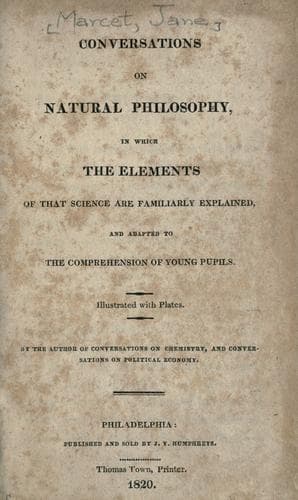
Conversations on Natural Philosophy, in which the Elements of that Science are Familiarly ExplainedMarcet, Mrs. (Jane Haldimand)
Science
Conversations on Natural Philosophy, in which the Elements of that Science are Familiarly Explained
Marcet, Mrs. (Jane Haldimand)
Physics
_Caroline._ Both the longest days, and the most perpendicular rays, are
on the 21st of June; and yet the greatest heat prevails in July and
August.
_Mrs. B._ Those parts of the earth which are once heated, retain the
heat for some length of time, and the additional heat they receive,
occasions an elevation of temperature, although the days begin to
shorten, and the sun's rays to fall more obliquely. For the same reason,
we have generally more heat at three o'clock in the afternoon, than at
twelve, when the sun is on the meridian.
_Emily._ And pray, have the other planets the same vicissitudes of
seasons, as the earth?
_Mrs. B._ Some of them more, some less, according as their axes deviate
more or less from the perpendicular, to the plane of their orbits. The
axis of Jupiter, is nearly perpendicular to the plane of his orbit; the
axes of Mars, and of Saturn, are each, inclined at angles of about sixty
degrees; whilst the axis of Venus is believed to be elevated only
fifteen or twenty degrees above her orbit; the vicissitudes of her
seasons must therefore be considerably greater than ours. For further
particulars respecting the planets, I shall refer you to Bonnycastle's
Introduction to Astronomy.
I have but one more observation to make to you, relative to the earth's
motion; which is, that although we have but 365 days and nights in the
year, she performs 366 complete revolutions on her axis, during that
time.
_Caroline._ How is that possible? for every complete revolution must
bring the same place back to the sun. It is now just twelve o'clock, the
sun is, therefore, on our meridian; in twenty-four hours will it not
have returned to our meridian again, and will not the earth have made a
complete rotation on its axis?
_Mrs. B._ If the earth had no progressive motion in its orbit whilst it
revolves on its axis, this would be the case; but as it advances almost
a degree westward in its orbit, in the same time that it completes a
revolution eastward on its axis, it must revolve nearly one degree more
in order to bring the same meridian back to the sun.
_Caroline._ Oh, yes! it will require as much more of a second revolution
to bring the same meridian back to the sun, as is equal to the space the
earth has advanced in her orbit; that is, nearly a degree; this
difference is, however, very little.
_Mrs. B._ These small daily portions of rotation, are each equal to the
three hundred and sixty-fifth part of a circle, which at the end of the
year amounts to one complete rotation.
_Emily._ That is extremely curious. If the earth then, had no other than
its diurnal motion, we should have 366 days in the year.
_Mrs. B._ We should have 366 days in the same period of time that we now
have 365; but if we did not revolve round the sun, we should have no
natural means of computing years.
Public-domain text, read in full here on John Shaqi.
Reviews
Reviews
No reviews yet
Be the first to share your thoughts on this work.
Elsewhere in the archive
Join the Discussion
Join the discussion
Sign in to leave a comment or review.
Sign InorCreate an account