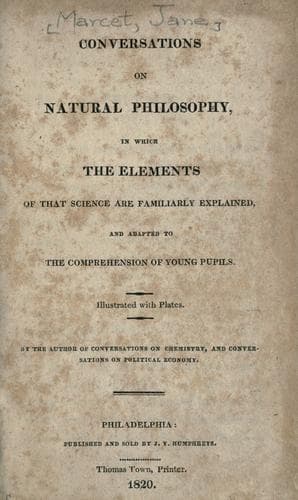
Conversations on Natural Philosophy, in which the Elements of that Science are Familiarly ExplainedMarcet, Mrs. (Jane Haldimand)
Science
Conversations on Natural Philosophy, in which the Elements of that Science are Familiarly Explained
Marcet, Mrs. (Jane Haldimand)
Physics
You will be surprised to hear, that if time is calculated by the stars
instead of the sun, the irregularity which we have just noticed does not
occur, and that one complete rotation of the earth on its axis, brings
the same meridian back to any fixed star.
_Emily._ That seems quite unaccountable; for the earth advances in her
orbit with regard to the fixed stars, the same as with regard to the
sun.
_Mrs. B._ True, but then the distance of the fixed stars is so immense,
that our solar system is in comparison to it but a spot, and the whole
extent of the earth's orbit but a point; therefore, whether the earth
remain stationary, or whether it revolved in its orbit during its
rotation on its axis, no sensible difference would be produced with
regard to the fixed stars. One complete revolution brings the same
meridian back to the same fixed star; hence the fixed stars appear to go
round the earth in a shorter time than the sun by three minutes
fifty-six seconds of time.
_Caroline._ These three minutes fifty-six seconds is the time which the
earth takes to perform the additional three hundred and sixty-fifth part
of the circle, in order to bring the same meridian back to the sun.
_Mrs. B._ Precisely. Hence the stars gain every day three minutes
fifty-six seconds on the sun, which makes them rise that portion of time
earlier every day.
When time is calculated by the stars it is called sidereal time; when by
the sun, solar, or apparent time.
_Caroline._ Then a sidereal day is three minutes fifty-six seconds
shorter, than a solar day of twenty-four hours.
_Mrs. B._ I must also explain to you what is meant by a sidereal year.
The common year, called the solar or tropical year, containing 365 days,
five hours, forty-eight minutes and fifty-two seconds, is measured from
the time the sun sets out from one of the equinoxes, or solstices, till
it returns to the same again; but this year is completed, before the
earth has finished one entire revolution in its orbit.
_Emily._ I thought that the earth performed one complete revolution in
its orbit, every year; what is the reason of this variation?
_Mrs. B._ It is owing to the spheroidal figure of the earth. The
elevation about the equator produces much the same effect as if a
similar mass of matter, collected in the form of a moon, revolved round
the equator. When this moon acted on the earth, in conjunction with, or
in opposition to the sun, variations in the earth's motion would be
occasioned, and these variations produce what is called the precession
of the equinoxes.
[Illustration: PLATE XI.]
_Emily._ What does that mean? I thought the equinoctial points, were
fixed points in the heavens, in which the equator cuts the ecliptic.
Public-domain text, read in full here on John Shaqi.
Reviews
Reviews
No reviews yet
Be the first to share your thoughts on this work.
Elsewhere in the archive
Join the Discussion
Join the discussion
Sign in to leave a comment or review.
Sign InorCreate an account