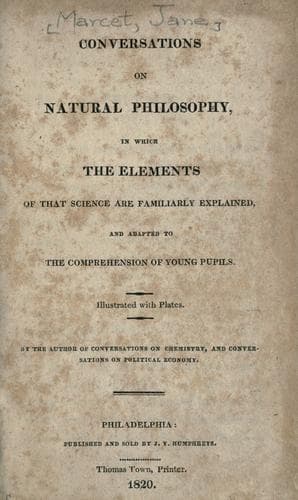
Conversations on Natural Philosophy, in which the Elements of that Science are Familiarly ExplainedMarcet, Mrs. (Jane Haldimand)
Science
Conversations on Natural Philosophy, in which the Elements of that Science are Familiarly Explained
Marcet, Mrs. (Jane Haldimand)
Physics
_Mrs. B._ These points are not quite fixed, but have an apparently
retrograde motion, among the signs of the zodiac; that is to say,
instead of being at every revolution in the same place, they move
backwards. Thus if the vernal equinox is at A, (fig. 1. plate XI.) the
autumnal one, will be at B, instead of C, and the following vernal
equinox, at D, instead of at A, as would be the case if the equinoxes
were stationary, at opposite points of the earth's orbit.
_Caroline._ So that when the earth moves from one equinox to the other,
though it takes half a year to perform the journey, it has not travelled
through half its orbit.
_Mrs. B._ And, consequently, when it returns again to the first equinox,
it has not completed the whole of its orbit. In order to ascertain when
the earth has performed an entire revolution in its orbit, we must
observe when the sun returns in conjunction with any fixed star; and
this is called a sidereal year. Supposing a fixed star situated at E,
(fig. 1. plate XI.) the sun would not appear in conjunction with it,
till the earth had returned to A, when it would have completed its
orbit.
_Emily._ And how much longer is the sidereal, than the solar year?
_Mrs. B._ Only twenty minutes; so that the variation of the equinoctial
points is very inconsiderable. I have given them a greater extent in the
figure, in order to render them sensible.
In regard to time, I must further add, that the earth's diurnal motion
on an inclined axis, together with its annual revolution in an elliptic
orbit, occasions so much complication in its motion, as to produce many
irregularities; therefore the true time cannot be measured by the
apparent place of the sun. A perfectly correct clock, would in some
parts of the year be before the sun, and in other parts after it. There
are but four periods in which the sun and a perfect clock would agree,
which is the 15th of April, the 16th of June, the 23d of August, and the
24th of December.
_Emily._ And is there any considerable difference between solar time,
and true time?
_Mrs. B._ The greatest difference amounts to between fifteen and sixteen
minutes. Tables of equation are constructed for the purpose of pointing
out, and correcting these differences between solar time and equal or
mean time, which is the denomination given by astronomers, to true time.
Questions
1. (Pg. 92) What does the line A B, (fig. 2 plate 8.) represent, and
what are its extremities called?
2. (Pg. 92) What is meant by the equator, and how is it situated?
3. (Pg. 92) There are two hemispheres; how are they named and
distinguished?
4. (Pg. 92) What are the circles near the poles called?
5. (Pg. 92) What do the lines I K, and L M, represent?
6. (Pg. 92) What circle is in part represented by the line L K?
7. (Pg. 92) Against what mistake must you guard respecting this line?
8. (Pg. 92) What is meant by a plane, and how could one be represented?
Public-domain text, read in full here on John Shaqi.
Reviews
Reviews
No reviews yet
Be the first to share your thoughts on this work.
Elsewhere in the archive
Join the Discussion
Join the discussion
Sign in to leave a comment or review.
Sign InorCreate an account