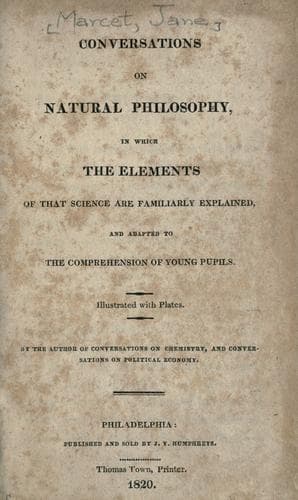
Conversations on Natural Philosophy, in which the Elements of that Science are Familiarly ExplainedMarcet, Mrs. (Jane Haldimand)
Science
Conversations on Natural Philosophy, in which the Elements of that Science are Familiarly Explained
Marcet, Mrs. (Jane Haldimand)
Physics
9. (Pg. 93) Describe what is intended by the plane of the earth's orbit.
10. (Pg. 93) Extending this plane to the fixed stars, what circle would
it form, and among what particular stars would it be found?
11. (Pg. 93) What is fig. 1. plate 9, designed to represent?
12. (Pg. 93) The ecliptic does not properly belong to the earth, for
what purpose then is it described on the terrestrial globe?
13. (Pg. 93) What does the obliquity of the ecliptic to the equator
serve to show?
14. (Pg. 93) Within what limits do you find the torrid zone?
15. (Pg. 93) What two zones are there between the torrid, and the two
frigid zones?
16. (Pg. 93) Where are the frigid zones situated?
17. (Pg. 93) What is meant by the term zone; and are the frigid zones
properly so called?
18. (Pg. 93) How do meridian lines extend, and what is meant by the
meridian of a place?
19. (Pg. 93) What is said of the meridian to which the sun is opposite,
and where is it then midnight?
20. (Pg. 94) What hour is it then, at places exactly half way between
these meridians?
21. (Pg. 94) How are greater and lesser circles distinguished?
22. (Pg. 94) What part of a circle is a degree, and how are these
further divided?
23. (Pg. 94) What is the diameter, and what the circumference of a
circle, and what proportion do they bear to each other?
24. (Pg. 94) What part of a circle is a meridian?
25. (Pg. 94) How many degrees are there between the equator and the
poles?
26. (Pg. 94) Into what parts, besides degrees, is the ecliptic divided?
27. (Pg. 94) How are degrees of latitude measured, and to what number do
they extend?
28. (Pg. 94) On what circles are degrees of longitude measured, and to
what number do they extend?
29. (Pg. 94) What is a parallel of latitude?
30. (Pg. 95) Degrees of longitude vary in length; what is the cause of
this?
31. (Pg. 95) What is the length of a degree of latitude, and why do not
these vary?
32. (Pg. 95) What causes the equator to be somewhat larger than a great
circle passing through the poles, and what effect has this on degrees of
longitude measured on the equator?
33. (Pg. 95) What is the cause of this form being given to the earth?
34. (Pg. 96) What would have been a consequence of the centrifugal
force, had the earth been a perfect sphere?
35. (Pg. 96) A body situated at the poles, is attracted more forcibly
than if placed at the equator, what is the reason?
36. (Pg. 97) What effect would be produced upon the gravity of a body,
were it placed beneath the surface of the earth, and what supposing it
at its centre?
37. (Pg. 97) What two circumstances combine, to lessen the weight of a
body on the equator?
38. (Pg. 97) Why could not this be proved by weighing a body at the
poles, and at the equator?
39. (Pg. 98) What is a pendulum?
40. (Pg. 98) What causes it to vibrate?
41. (Pg. 98) Why are not its vibrations perpetual?
Public-domain text, read in full here on John Shaqi.
Reviews
Reviews
No reviews yet
Be the first to share your thoughts on this work.
Elsewhere in the archive
Join the Discussion
Join the discussion
Sign in to leave a comment or review.
Sign InorCreate an account