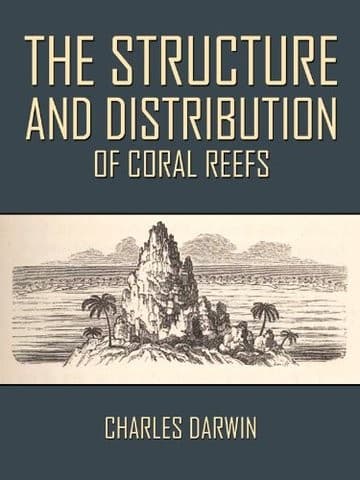
Beagle Expedition (1831-1836); Coral reefs and islands; Geology -- South America; Islands; Volcanoes
[23] Beechey’s “Voyage,” 4to edition, volume i, page 160. At
Whitsunday Island the bottom of the lagoon slopes gradually towards
the centre, and then deepens suddenly, the edge of the bank being
nearly perpendicular. This bank is formed of coral and dead shells.
In the midst of a group of atolls, there sometimes occur small, flat,
very low islands of coral formation, which probably once included a
lagoon, since filled up with sediment and coral-reefs. Captain Beechey
entertains no doubt that this has been the case with the two small
islands, which alone of thirty-one surveyed by him in the Low
Archipelago, did not contain lagoons. Romanzoff Island (in lat. 15° S.)
is described by Chamisso[24]
as formed by a dam of madreporitic rock inclosing a flat space, thinly
covered with trees, into which the sea on the leeward side occasionally
breaks. North Keeling atoll appears to be in a rather less forward
stage of conversion into land; it consists of a horse-shoe shaped strip
of land surrounding a muddy flat, one mile in its longest axis, which
is covered by the sea only at high water. When describing South Keeling
atoll, I endeavoured to show how slow the final process of filling up a
lagoon must be; nevertheless, as all causes do tend to produce this
effect, it is very remarkable that not one instance, as I believe, is
known of a moderately sized lagoon being filled up even to the low
water-line at spring-tides, much less of such a one being converted
into land. It is, likewise, in some degree remarkable, how few atolls,
except small ones, are surrounded by a single linear strip of land,
formed by the union of separate islets. We cannot suppose that the many
atolls in the Pacific and Indian Oceans all have had a late origin, and
yet should they remain at their present level, subjected only to the
action of the sea and to the growing powers of the coral, during as
many centuries as must have elapsed since any of the earlier tertiary
epochs, it cannot, I think, be doubted that their lagoons and the
islets on their reef, would present a totally different appearance from
what they now do. This consideration leads to the suspicion that some
renovating agency (namely subsidence) comes into play at intervals, and
perpetuates their original structure.
[24] Kotzebue’s “First Voyage,” volume iii., page 221.
SECTION III.—ATOLLS OF THE MALDIVA ARCHIPELAGO—GREAT CHAGOS BANK.
Maldiva Archipelago.—Ring-formed reefs, marginal and central.—Great
depths in the lagoons of the southern atolls.—Reefs in the lagoons all
rising to the surface.—Position of islets and breaches in the reefs,
with respect to the prevalent winds and action of the
waves.—Destruction of islets.—Connection in the position and submarine
foundation of distinct atolls.—The apparent disseverment of large
atolls.—The Great Chagos Bank.—Its submerged condition and
extraordinary structure.
Public-domain text, read in full here on John Shaqi.
Reviews
Reviews
No reviews yet
Be the first to share your thoughts on this work.
Join the Discussion
Join the discussion
Sign in to leave a comment or review.
Sign InorCreate an account