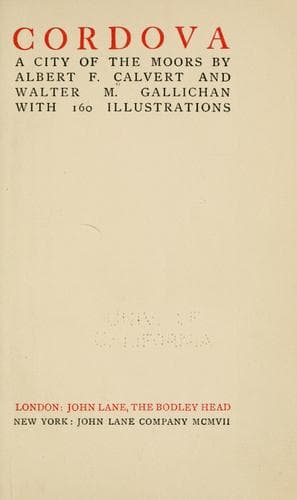
Cordova: A city of the MoorsCalvert, Albert Frederick
History
Cordova: A city of the Moors
Calvert, Albert Frederick
Arabs -- Spain; Córdoba (Spain) -- Description and travel; Córdoba (Spain) -- History
Abd-er-Rahman, a brave prince of a family that had ruled Damascus, was
born in troubled times in the camp before that city. Es-Deffah had
seized upon the throne; the family of the Omeyyads was hurled from
power. While under sentence of death for his attempt to restore the
fortunes of his family, Abd-er-Rahman passed a period of wandering among
Arab herdsmen. His dream was of Andalusia, where the supporters of the
Omeyyads were still numerous and powerful; and by dint of energy and
enthusiasm the young prince contrived to form a corps of one thousand
Arabs.
Abdulmalek Ibn Kattan, who had usurped rulership in Cordova, had been
defeated by the adventurous Balj at the head of a troop of Syrians. The
luckless Abdulmalek, after falling into the hands of Balj, was crucified
in a field outside Cordova, with a hog on one side and a dog on the
other. Until recovered by friends and removed for burial, the body of
the conquered sultan was left upon the cross as a menace to his
followers.
But Balj enjoyed only a short spell of power, for at the end of eleven
months he was forced to encounter the redoubtable prince of the
Omeyyads, whose army of Arabs was largely augmented by fierce partisans
in Spain.
Marching upon Cordova, Abd-er-Rahman besieged the city. Balj was
wounded, and his injuries caused his death. From this time, for about
three centuries, the capital of Andalusia was held by the Omeyyad line,
and during this rule the city reached the highest stage of its might and
magnificence. The Arab writers state that the independent khalifate of
Cordova was founded by Abd-er-Rahman I., after conquering Yusuf, who
reigned in the city. Yusuf resisted the Omeyyad troops outside the walls
of Cordova, and, being worsted, he retired. Abd-er-Rahman then entered
the city, and appointing the command to Abu Othman, went in pursuit of
the remnant of Yusuf’s army. Meanwhile Yusuf counter-marched, returned
to Cordova, and assailed Abu Othman, promising him future security for
himself and his relatives if he would surrender.
It is said that Othman refused to accept the terms of surrender. But
eventually Yusuf and Abd-er-Rahman came to an agreement, and both
monarchs lived in the city (A.D. 757) in amity. The treaty was, however,
afterwards broken by Yusuf, who left his palace, collected a force, and
made war in Andalusia. He was frustrated by the Governor of Seville, but
after the conflict Yusuf escaped to Toledo. Here he was recognised in
the street, and murdered, by spies who hoped to receive reward for their
fealty to Abd-er-Rahman. Yusuf’s head was sent to Cordova, and nailed to
an arch of the bridge, together with the head of his son.
Public-domain text, read in full here on John Shaqi.
Reviews
Reviews
No reviews yet
Be the first to share your thoughts on this work.
Join the Discussion
Join the discussion
Sign in to leave a comment or review.
Sign InorCreate an account