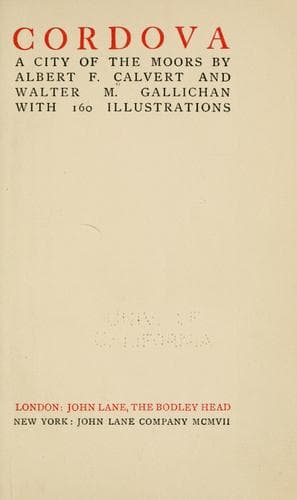
Cordova: A city of the MoorsCalvert, Albert Frederick
History
Cordova: A city of the Moors
Calvert, Albert Frederick
Arabs -- Spain; Córdoba (Spain) -- Description and travel; Córdoba (Spain) -- History
Upon attaining the throne, Abd-er-Rahman began to turn his energies to
the development of Cordova. He had a passion for building. A new palace
arose, mosques and baths were erected, and an aqueduct was constructed
to bring pure water from the mountains. In 786 Abd-er-Rahman supervised
the building of the huge and splendid Mezquita.
In character the first Omeyyad ruler was humane, eloquent, and brave. He
had red hair, a fresh skin, and high cheek-bones. His form was tall and
supple, and he was fond of exercise, especially the sport of falconry.
His dress was always of white linen, and he lived simply.
There are, however, blots upon the reputation of Abd-er-Rahman I. He was
of violent temper, and subject to strong prejudices. His treatment of
Abu Othman, Temain, and other allies, who had assisted him in gaining
power, was not generous. He reigned for over thirty-three years, and was
buried in Cordova.
Hisham, son of Abd-er-Rahman, succeeded in the government of Cordova. He
was esteemed as a wise king, and under his direction the work of
building and adorning the Mezquita was continued. Hisham founded schools
for teaching the Arabic language, and he restored the long bridge over
the Guadalquivir.
The next ruler was Hakem, who continued the work of enlarging and
improving the mosque. This sovereign was soon confronted with the trials
of a rebellion in the city, and a very grievous period of famine. A poet
of Cordova wrote:
‘Time has brought on sterility and famine, but the calamity itself
has proved a benefit to Al-Hakem.
It has insured his rule, and delivered him of many a rebellious
subject.’
Hakem was the first king to give regular pay to the army. He left a
family of twenty boys and twenty girls, and the throne descended to one
of his sons, Abd-er-Rahman II.
The fourth Omeyyad sultan was an encourager of poets, painters, and
philosophers. Abu Meruan, the illustrious historian, lived in this
reign, and Ziryāb, the distinguished musician, was a court favourite.
When Ziryāb was on his way to the city of culture and the arts, his
royal patron went out to receive him with honour and pomp. Being himself
a poet and a passionate worshipper of music, Abd-er-Rahman II. was a
true friend of all artists.
Ziryāb, the composer, was singularly versatile. We read that he invented
a new process for making linen white, that he introduced asparagus into
Andalusia, invented a crystal ware, and taught the use of leather beds.
It is interesting to learn that the harem of the second Abd-er-Rahman
contained several cultured women. One of these was Tarūb, a favourite
concubine, to whom the monarch addressed these lines:
‘When the sun rises every day to give us light, it reminds
me of Tarūb.
I am the happiest of mortals, since I am successful in love
and prosperous in war.’
Another beauty of the court was Kalam, a woman of learning. She recited
poetry and was gifted in music.
Public-domain text, read in full here on John Shaqi.
Reviews
Reviews
No reviews yet
Be the first to share your thoughts on this work.
Join the Discussion
Join the discussion
Sign in to leave a comment or review.
Sign InorCreate an account