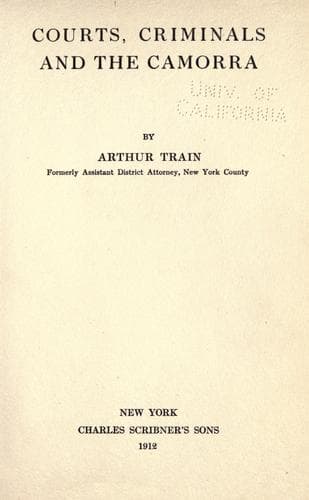
Courts, Criminals and the CamorraTrain, Arthur Cheney
History
Courts, Criminals and the Camorra
Train, Arthur Cheney
Camorra; Criminals -- United States; Justice, Administration of -- United States
Before commenting too harshly upon this mote in the eye of Italian
procedure, it may not be unwise to consider whether any similar
beam exists in our own. Certainly there is a deal of interruption,
contradiction, and disputation in our own criminal courts which
sometimes is not only undignified, but frequently ends in an unseemly
dispute between judge and lawyers. Contempt of court is very general
in the United States, and we have practically no means for punishing
it. Moreover, these scenes in our own courts do not usually assist
in getting at the truth. With us, once a witness has spoken and his
testimony has become a matter of record, whether he has said what he
meant to say or not (under the complicated questions put in examination
and cross-examination), or whether or not he has succeeded in giving
an accurate impression of what he saw or knows, he is hustled out of
the way and made to keep silence. He has little, if any, chance to
explain or annotate his testimony. A defendant may go to jail or be
turned loose on the community because the witness really didn’t get a
chance to tell his own story in his own way. Now, the witness’s own
story in precisely his own way is just what they are looking for under
the inquisitorial procedure, and if he is misinterpreted they want
to know it. The process may take longer, but it makes for getting at
the truth, and the Italians regard a criminal trial as of even more
importance than do some of our judges, who often seem more anxious to
get through a record-breaking calendar and “dispose of” a huge batch
of cases than to get at the exact facts in any particular one. There
is nothing “hit or miss” about the Continental method. Whatever its
shortcomings, whatever its limitations to the cold Anglo-Saxon mind,
it brings out all the details and the witness’s reasons. At an Italian
trial a witness might testify (and his evidence be considered as
important) that he heard sounds of a scuffle and a man’s voice exclaim,
“You have stabbed me, Adolfo!” that somebody darted across the street
and into an alley, that an old woman whom he identifies in court as the
deceased’s mother, and who was standing beside him, cried out, “That is
my son’s voice!” and that three or four persons came running up from
several different locations, each of whom described, circumstantially
and independently, a murder which he had seen perpetrated, identifying
the assassin by name.
In America it is doubtful whether in most jurisdictions the witness
would be permitted to testify to anything except that he heard a
scuffle, saw a man run away, and that an old woman and several other
people thereupon said _something_.
Public-domain text, read in full here on John Shaqi.
Reviews
Reviews
No reviews yet
Be the first to share your thoughts on this work.
Elsewhere in the archive
Join the Discussion
Join the discussion
Sign in to leave a comment or review.
Sign InorCreate an account