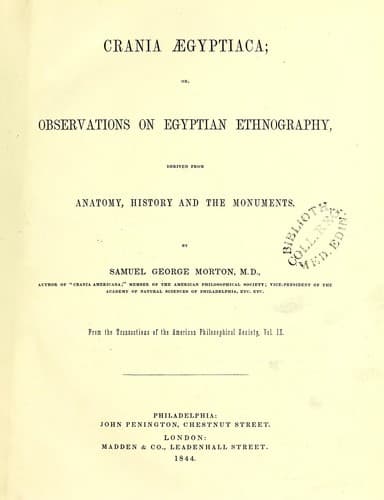
Crania Ægyptiaca: Or, Observations on Egyptian Ethnography Derived from Anatomy, History and the MonumentsMorton, Samuel George
History
Crania Ægyptiaca: Or, Observations on Egyptian Ethnography Derived from Anatomy, History and the Monuments
Morton, Samuel George
Craniology -- Egypt; Ethnology -- Egypt
Plate III., Fig. 7. (Cat. 802.) A finely developed cranium, with a
delicate, but rather prominent face, and strongly arched nose.
Probably a female of 50 years.—I.C. 81 cubic inches. _Egypto-Pelasgic
form._
Plate III., Fig. 8. (Cat. 803.) A large, oval head, with a broad,
receding forehead, low coronal region, and salient nose. A man of 45
or 50 years.—I. C. 92 cubic inches. F.A. 82°. _Pelasgic form._
(Cat. 800.) Skull of a child of 10 years, with a receding forehead,
narrow, projecting face, and salient teeth. _Negroid form._
(Cat. 801.) A juvenile head, heavy, but beautifully proportioned,
especially in the frontal region. _Pelasgic form._
Plate III., Fig. 9. (Cat. 825.) A large and remarkably intellectual
head, of the finest proportions throughout. The hair is in part
preserved, and is long, smooth and of a dark-brown colour.—I. C. 93
cubic inches. F. A. 81°. _Pelasgic form._
E.—FROM TOORA, ON THE NILE.
Plate II., Fig. 9. (Cat. 840.) Skull of a man from the ancient
quarries at Toora, opposite Memphis, on the east bank of the Nile,
about seven miles above Cairo. From this place the stones were
obtained for building the Pyramids of Gizeh, and many later
structures, down to the epoch of the Ptolemies. Mr. Gliddon was
present at the exhumation of several of these crania, yet, owing to
their extremely fragile state, but one reached me in safety, and for
this I am indebted to the kindness of Mr. Mash. They were found in
rude sarcophagi of limestone, and wrapped in coarse matting. These
remains, which were discovered in 1837-38, are supposed to have
pertained to the master-quarrymen.
The head figured is of an elongated oval form, with a moderate frontal
development and low coronal region. The nose is strongly salient and
aquiline, and the whole cranial structure thin and delicate.—I. C. 89
cubic inches. F. A. 79°. _Pelasgic form._
_Remarks on the preceding series of Crania._—A mere glance at this
group of skulls will satisfy any one accustomed to comparisons of this
kind, that most of them possess the Caucasian traits in a most
striking and unequivocal manner, whether we regard their form, size,
or facial angle. It is, in fact, questionable whether a greater
proportion of beautifully moulded heads would be found among an equal
number of individuals taken at random from any existing European
nation. The entire series consists of sixteen examples of the Pelasgic
and seven of the Egyptian form, a single Semitic head, one of the
Negroid variety, and one of mixed conformation. Of the antiquity of
these remains there can be no question; and with respect to a part of
them, those from the Pyramid of Five Steps, we have evidence of a more
precise character.
Public-domain text, read in full here on John Shaqi.
Reviews
Reviews
No reviews yet
Be the first to share your thoughts on this work.
Join the Discussion
Join the discussion
Sign in to leave a comment or review.
Sign InorCreate an account