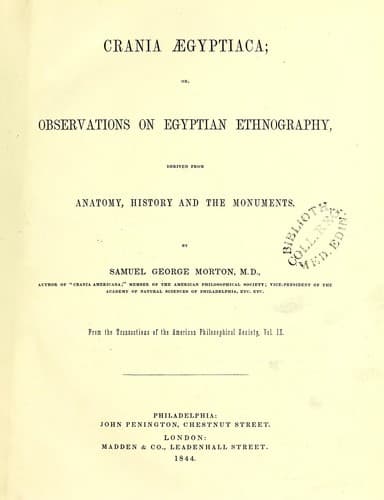
Crania Ægyptiaca: Or, Observations on Egyptian Ethnography Derived from Anatomy, History and the Monuments — John Shaqi
Crania Ægyptiaca: Or, Observations on Egyptian Ethnography Derived from Anatomy, History and the MonumentsMorton, Samuel George
History
Crania Ægyptiaca: Or, Observations on Egyptian Ethnography Derived from Anatomy, History and the Monuments
Morton, Samuel George
Craniology -- Egypt; Ethnology -- Egypt
These most ancient mummies appear to have been prepared with but
little bitumen, and to have undergone desiccation by some primitive
and simple process of embalming; such, for example, as first
saturating the body in natron, and then subjecting it to heat in an
oven. It is also to be remarked, that in these two heads the brain has
not been removed through the nostrils, according to the general
custom, for the ethmoid bone is unbroken; and the cranial contents
could therefore only have been withdrawn through the foramen magnum at
the base of the skull.
This last remark also applies to sixteen other heads of this series;
whence I was at first led to suppose that they could not pertain to a
very remote epoch. But when we find that the oldest remains are
similarly characterized, and bear in mind that the removal of the
brain through the nose was a conventional part of the more perfect art
of embalming, may we not suppose that this imperforate state of the
cranium points to an early epoch of Egyptian history, before mankind
had resorted to those elaborate methods of preserving the dead body
which are so remarkable in the _Theban_ catacombs? It has been
conjectured, that the proximity of the Natron Lakes to the city of
Memphis gave rise to the custom of embalming; and it is not an
improbable supposition that the profuse employment of bitumen was a
subsequent refinement of the art. This suggestion derives some support
from another fact; namely, that in every instance in which I have
observed the brain to have been removed through the nose, the bones
and integuments are much more charged with bitumen than in the
imperforate crania.
It may, perhaps, be conjectured by some that the Pelasgic heads of
this series belong to the Ptolemaic epoch, and hence pertain to the
Greek inhabitants of that age: but it must be remembered that the rule
of the Ptolemies lasted but about three hundred years; whereas the
Egyptians were themselves the masters of Memphis, and entombed their
dead in its necropolis more than two thousand years before either the
Persians or Greeks effected the conquest of the country, no less than
during the period of and after these epochs of foreign domination.
Of the sixteen adult Pelasgic skulls in this series, two or three are
small; yet the whole number gives about 88 cubic inches for the
average internal capacity of the cranium, or size of the brain, while
the mean of the facial angle is 80°. The seven Egyptian crania have a
mean internal capacity of 80 cubic inches, and a facial angle of 77°.
------------------------------------------------------------------------
SECOND SERIES.
FOUR HEADS FROM THE GROTTOES OF MAABDEH, NEAR MAGARAT-ES-SAMÒUN.
Public-domain text, read in full here on John Shaqi.
Reviews
Reviews
No reviews yet
Be the first to share your thoughts on this work.
Join the Discussion
Join the discussion
Sign in to leave a comment or review.
Sign InorCreate an account