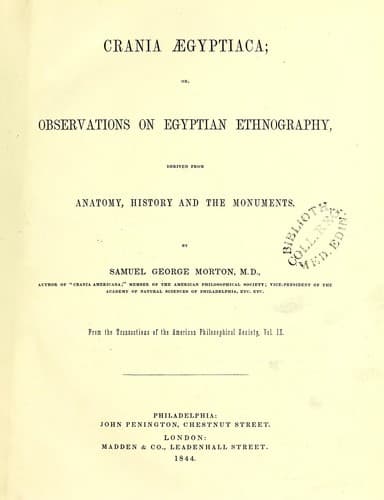
Crania Ægyptiaca: Or, Observations on Egyptian Ethnography Derived from Anatomy, History and the MonumentsMorton, Samuel George
History
Crania Ægyptiaca: Or, Observations on Egyptian Ethnography Derived from Anatomy, History and the Monuments
Morton, Samuel George
Craniology -- Egypt; Ethnology -- Egypt
THIRD SERIES.
FOUR SKULLS FROM ABYDOS.
The city of Abydos, the second in size in the Thebaid, was on the west
bank of the Nile, and, like Thebes, possessed a palace of Rameses
III., and a temple of Osiris, the guardian divinity of the city.
Plate V., Fig. 1, (Cat. 819.) An elongated head, with an indifferent
frontal and low coronal region, straight nose, small orbits, and
prominent upper jaw.—I. C. 85 cubic inches. F. A. 79°. _Egyptian
form._
Plate V., Fig. 2. (Cat. 820.) A large and finely moulded cranium, with
a broad, full forehead, and long, but abruptly salient nose. The upper
jaw has a remarkable downward elongation, which reduces the F. A. to
76°.—I. C. 96 cubic inches. A man of 40. _Egyptian form._
Plate V., Fig. 3. (Cat. 817.) A large, beautifully developed cranium,
of harmonious proportions, but somewhat ponderous structure.—I. C. 89
cubic inches. F. A. 80°. _Pelasgic form._
Plate V., Fig. 4. (Cat. 818.) A small head, narrow and retreating,
with a tumid occiput, very large, aquiline nose, and delicate,
prominent face.—I. C. 69 cubic inches. F. A. 77°. _Semitic form._
_Remarks._—In a memorandum accompanying these skulls, Mr. Gliddon
observes that “they were obtained from a mummy-pit behind the temple
of Rameses III., and they belong to the best class. Among the relics
found in the same pit were a scarabæus, bearing the prenomen of
Thotmes IV., and a piece of stamped pottery, (apparently enclosed with
a mummy to denote the epoch,) which bore the nomen of Rameses III. It
may, therefore, be reasonably conjectured, that these remains belong
to the eighteenth Diospolitan dynasty, fixed by Professor Rosellini
between the years 1822 and 1874, B.C.”
The four heads are entirely denuded, but little appearance of bitumen
remaining; nor is the ethmoid bone perforated. The bones bear the
impress of age, and, in one instance, have become softened, and almost
friable, from decomposition.
------------------------------------------------------------------------
FOURTH SERIES.
FIFTY-FIVE HEADS FROM THE CATACOMBS OF THEBES.
The greater part of this extensive and singularly perfect and varied
series of heads, was collected by Mr. Gliddon during two visits to
Thebes. They were all taken from the catacombs at _El Gourna_, on the
western bank of the Nile. If we may judge by the different degrees of
care manifested in the embalming process, they embrace individuals of
every class excepting the highest and lowest; for the latter,
according to the testimony of Herodotus, were never embalmed in the
proper sense of that word; and the former were deposited in more
elaborate sepulchres.
Public-domain text, read in full here on John Shaqi.
Reviews
Reviews
No reviews yet
Be the first to share your thoughts on this work.
Join the Discussion
Join the discussion
Sign in to leave a comment or review.
Sign InorCreate an account