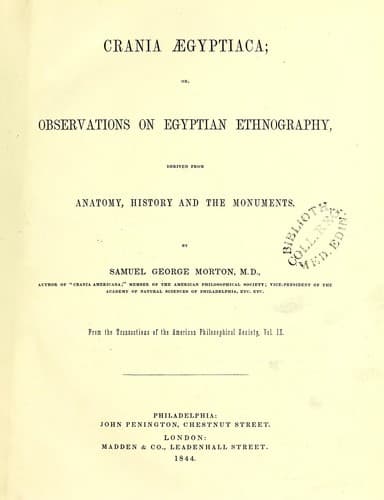
Crania Ægyptiaca: Or, Observations on Egyptian Ethnography Derived from Anatomy, History and the MonumentsMorton, Samuel George
History
Crania Ægyptiaca: Or, Observations on Egyptian Ethnography Derived from Anatomy, History and the Monuments
Morton, Samuel George
Craniology -- Egypt; Ethnology -- Egypt
This is the name of a series of sepulchral grottoes in Middle Egypt,
on the limestone hill opposite Manfaloot, and near the modern village
of Maabdeh. It is within the ancient nome of Heracleopolis. This
cemetery is a natural cavern, which was chiefly dedicated to embalmed
crocodiles, but in some measure, also, to man. Mr. Gliddon observes
that the human mummies are of the common order, and adds: “I brought
them from a measured distance of 438 feet under ground, horizontally,
averaging about twenty feet below the surface.”
Plate IV., Fig. 1. (Cat. 833.) A large, oval head, with a very low,
receding forehead, and large, aquiline nose. A man of 35 years? The
hair is long, soft, and curling, and the beard is partially preserved
on the lower jaw. _Pelasgic form?_
This person has been much disfigured by ulceration of the cartilage of
the nose and the adjacent integuments; part of the upper lip has been
removed by the disease, which appears partially on the lower jaw, and
may account for the beard not having been shaved. The embalming
process has been very carefully conducted. Large lozenge-shaped
patches of gold-leaf are seen on the centre of the forehead and over
each eye, with smaller pieces dispersed in other places, and
especially on the _bone_ and _teeth_ of the upper jaw, where these
have been denuded or exposed by ulceration.
Plate IV., Fig. 2. (Cat. 834.) A female head, of a short, oval form,
with a narrow, receding forehead, prominent nose, and very protruding
maxillæ. The teeth, which are salient, indicate a person of 25 or 30
years of age; and the lower jaw, which is very angular, has a
remarkable downward projection. The hair was long, but harsh, and was
necessarily removed with the integuments, on account of the imperfect
nature of the embalmment, which appeared to have been effected with a
soft or tar-like bitumen. _Negroid form._
Plate IV., Fig. 3. (Cat. 835.) A woman of 30? with a long, narrow
head, slightly salient nose, and very projecting face. The hair is
eight or ten inches long, harsh, but not wiry. _Negroid form._ I.C. 71
cubic inches. F.A. 73°.
Plate IV., Fig. 4. (Cat. 836.) A female head of a fine oval form, with
a broad, convex forehead, low coronal region, and strongly aquiline
nose. This head retains a profusion of long, fine, curling hair, and
the face is gilded over the eyes and lips. This is a striking example
of the _tumid face_ which is not unfrequently seen on the monuments.
_Egyptian form._
_Remarks._—The two Negroid heads belong, obviously, to the lower class
of people, for the bodies have been hastily and imperfectly embalmed,
without mummy cases, and in ordinary wrappings. The two latter remarks
apply to the other individuals of this series, which have,
nevertheless, been much more carefully embalmed.
------------------------------------------------------------------------
Public-domain text, read in full here on John Shaqi.
Reviews
Reviews
No reviews yet
Be the first to share your thoughts on this work.
Join the Discussion
Join the discussion
Sign in to leave a comment or review.
Sign InorCreate an account