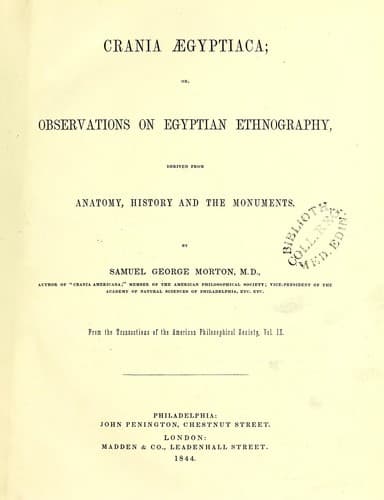
Crania Ægyptiaca: Or, Observations on Egyptian Ethnography Derived from Anatomy, History and the MonumentsMorton, Samuel George
History
Crania Ægyptiaca: Or, Observations on Egyptian Ethnography Derived from Anatomy, History and the Monuments
Morton, Samuel George
Craniology -- Egypt; Ethnology -- Egypt
Egypt is justly regarded as the parent of civilization, the cradle of
the arts, the land of mystery. Her monuments excite our wonder, and her
history confounds chronology; and the very people who thronged her
cities would be unknown to us, were it not for those vast sepulchres
whence the dead have arisen, as it were, to bear witness for themselves
and their country. Yet even now, the physical characteristics of the
ancient Egyptians are regarded with singular diversity of opinion by the
learned, who variously refer them to the Jews, Arabs, Hindoos, Nubians,
and Negroes. Even the details of organic structure have been involved in
the same uncertainty,—the configuration of the head, the position of the
ear, the form of the teeth, the colour of the skin, and the texture of
the hair; while the great question is itself undetermined—whether
civilization ascended or descended the Nile;—whether it had its origin
in Egypt or in Ethiopia. These conflicting opinions long since made me
desirous to investigate the subject for myself; but the many
difficulties in the way of obtaining adequate materials, compelled me to
suspend the inquiry; and it is only within a recent period that I have
been able effectively to resume it. It gives me great pleasure to state,
that my present facilities have been almost exclusively derived,
directly or indirectly, from the scientific zeal and personal friendship
of George R. Gliddon, Esq., late United States consul for the city of
Cairo. During a former visit to the United States, this gentleman
entered warmly into my views and wishes; and on his return to the East,
in 1838, he commenced his researches on my behalf; and in the course of
his various travels in Egypt and in Nubia, as far as the second
Cataract, he procured one hundred and thirty-seven human crania, of
which one hundred pertain to the ancient inhabitants of Egypt. Of these
last, seventeen were most obligingly sent me, at the instance of Mr.
Gliddon, by M. Clot Bey, the distinguished Surgeon in chief to the
Viceroy of Egypt. They are arranged by the latter gentleman into two
series, the Pharaonic, and the Ptolemaic; but without availing myself of
this classification, I have merely regarded them in reference to their
national characters.
Mr. Gliddon’s residence for the greater part of twenty-three years in
Egypt, and his varied official and other avocations, together with his
acquaintance with the people, and their languages, have given him
unusual facilities for collecting the requisite materials; while their
authenticity is amply vouched for by one who blends the character of a
gentleman with the attainments of a scholar.
The object of this memoir, therefore, will be to throw some additional
light on the questions to which I have adverted, and to ascertain, if
possible, the Ethnographic characters of the primitive Egyptians; or, in
other words, to point out their relative position among the races of
men.
Public-domain text, read in full here on John Shaqi.
Reviews
Reviews
No reviews yet
Be the first to share your thoughts on this work.
Join the Discussion
Join the discussion
Sign in to leave a comment or review.
Sign InorCreate an account