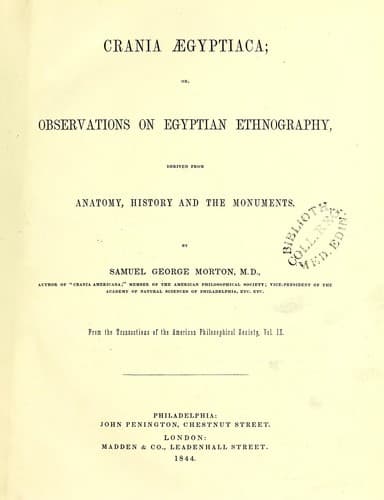
Crania Ægyptiaca: Or, Observations on Egyptian Ethnography Derived from Anatomy, History and the MonumentsMorton, Samuel George
History
Crania Ægyptiaca: Or, Observations on Egyptian Ethnography Derived from Anatomy, History and the Monuments
Morton, Samuel George
Craniology -- Egypt; Ethnology -- Egypt
It is necessary, however, to premise, that the materials in my
possession, were collected without the slightest bias of opinion on the
part of Mr. Gliddon, who, at the period in question, had paid no
particular attention to Ethnography; and indeed very many of these
crania were received by me in their original wrappings, which were first
removed, after the lapse of ages, by my own hands.
It is farther requisite to bear in mind, that, with a few exceptions I
have no clew whatever, whereby to ascertain or even to conjecture, the
epoch to which these remains have belonged. The Egyptian catacombs do
not always contain their original occupants; for these were often
displaced and the tombs re-sold for mercenary purposes: whence it
happens, that mummies of the Greek and Roman epochs have been found in
those more ancient receptacles which had received the bodies of Egyptian
citizens of a far earlier date. The bodies thus displaced, however,
_were not destroyed_; and the Egyptians of at least twenty-five
centuries before our era, though for the most part mingled without
regard to rank or epoch, are still preserved in their interminable
cemeteries.
I disclaim all knowledge of hieroglyphic literature; but I may express
my conviction that the past discoveries and pending researches of Young,
Champollion, Rosellini, Wilkinson, Lepsius, and some other illustrious
men, are destined to unravel much that has hitherto been regarded as
mystical in Egyptian history; while the invaluable disclosures which
they have already made, entitle them to the lasting gratitude of the
student of Archæology.
A few words in reference to chronology. Rosellini places the accession
of the Sixteenth dynasty of Egyptian kings at 2272 years before Christ.
Champollion adopts a nearly similar arrangement. The learned Dr. Wiseman
admits that there are monuments in Egypt as old as 2200 years before our
era; and Dr. Prichard dates the accession of Menes two centuries earlier
in time. The veneration with which these authors regard the Sacred
Writings, has given me the greater confidence in their opinions, which I
therefore adopt in general for the distant landmarks of time; especially
as the latter come fairly within the range of the Septuagint chronology,
which places the epoch of the Deluge at 3154 years B.C., and thus gives
room for the most ancient of the Egyptian monuments. In respect to later
and subordinate dates, I have been governed exclusively by the published
system of Professor Rosellini, which is regarded by competent judges as
more complete than any other.
I have great pleasure in stating, that for the unrestricted use of the
first copy of Rosellini’s splendid work which was brought to the United
States, I am indebted to an accomplished traveller, Richard K. Haight,
Esq., of New York; a gentleman who devotes his leisure hours and opulent
income to the promotion of archaeological knowledge.
Public-domain text, read in full here on John Shaqi.
Reviews
Reviews
No reviews yet
Be the first to share your thoughts on this work.
Join the Discussion
Join the discussion
Sign in to leave a comment or review.
Sign InorCreate an account