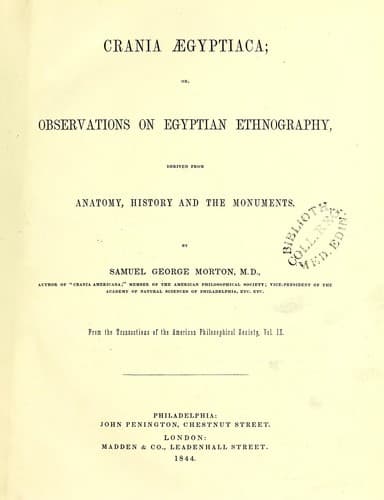
Crania Ægyptiaca: Or, Observations on Egyptian Ethnography Derived from Anatomy, History and the MonumentsMorton, Samuel George
History
Crania Ægyptiaca: Or, Observations on Egyptian Ethnography Derived from Anatomy, History and the Monuments
Morton, Samuel George
Craniology -- Egypt; Ethnology -- Egypt
_The Structure of the Cranial Bones_ is as thin and delicate as in the
European, and a ponderous skull is of unfrequent occurrence. I make
this remark with the more satisfaction because it enables me to
contest one of the observations of Herodotus; who tells us, that on
visiting the field of battle whereon the Egyptians had fought with the
Persians, he saw the bones of the latter lying on one side, and those
of their enemies on the other. He then adds, that “the skulls of the
former were so extremely soft as to yield to the slightest impression,
even of a pebble; those of the Egyptians, on the contrary, were so
firm that the blow of a large stone would hardly break them.” The
historian then explains the reason of this difference, by stating that
the Egyptians have thicker skulls, because their heads are frequently
shaved and more exposed to the weather: while the Persians have soft
skulls, owing to the habitual use of caps which protect their heads
from the sun.
These reveries are wholly untenable in a physiological point of view,
and derive not the smallest support from anatomy itself; nor can there
be a question that the confiding historian received his impressions
through the ignorance or imposition of others. I have in my possession
eight skulls of Fellahs, or modern Egyptian peasants, who habitually
shave the head, and wear a thin cap; and yet their skulls, which are
of various ages from early youth to senility, are without exception
thin and delicate.
Some modern authors have also attributed to the mummy skulls a
_density_ which is not characteristic, but which is adventitiously
acquired by the infiltration of bitumen into the diplöic structure
during the process of embalming.
_Hair._—The hair is fortunately preserved on thirty-six heads, in some
instances in profusion, in others scantily, but always in sufficient
quantity to enable us to judge of its texture. Thirty-one of these
examples pertain to the Caucasian series, and in these the hair is as
fine as that of the fairest European nations of the present day. The
embalming process has changed it, with a few exceptions, from a black
to a dark-brown colour. There are also several instances of gray hair,
and two in which it is of a true flaxen colour: it is more than
probable, however, that the latter hue has been produced
artificially,—a practice still in use among the Saumaulies south of
Adel.
Public-domain text, read in full here on John Shaqi.
Reviews
Reviews
No reviews yet
Be the first to share your thoughts on this work.
Join the Discussion
Join the discussion
Sign in to leave a comment or review.
Sign InorCreate an account