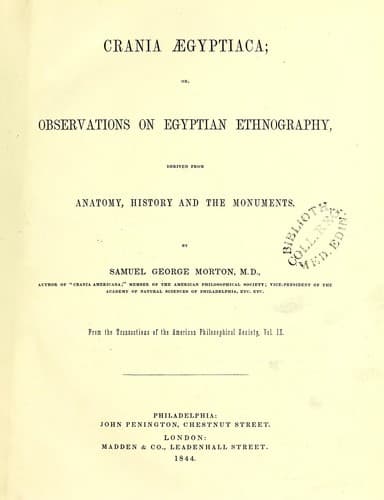
Crania Ægyptiaca: Or, Observations on Egyptian Ethnography Derived from Anatomy, History and the MonumentsMorton, Samuel George
History
Crania Ægyptiaca: Or, Observations on Egyptian Ethnography Derived from Anatomy, History and the Monuments
Morton, Samuel George
Craniology -- Egypt; Ethnology -- Egypt
The preceding remarks on the texture of the hair accord with those of
other observers, as well as with the monumental evidences of every
epoch. Belzoni obtained plaited hair from the Theban catacombs
eighteen inches in length; and M. Villoteau mentions another instance,
from the same tombs, in which the tresses must have reached to the
waist. Entire wigs of the same character are preserved, as every one
knows, in the British and Berlin museums; and I also possess, through
the kindness of Mr. Gliddon, a portion of a similar relic from Thebes,
which is elaborately wrought into a great number of long and most
delicate tresses.
These facts lead to a few observations on the celebrated passage of
Herodotus, who, when speaking of the Colchians, gives, among other
proofs of their Egyptian lineage, that they “were black, and had short
curling hair.” [Greek: Melanchroes kai oulotriches]. The above
translation, which is that of the learned Beloe, expresses, in respect
to the mode of _wearing_ the hair, precisely what is verified by my
observations; for in nearly all the Caucasian heads on which it has
been allowed to grow, it is remarkable for a profusion of short curls
of extreme fineness,—a character which is preserved in several of the
accompanying delineations.
Herodotus farther tells us that the Egyptians kept their heads shaved;
or perhaps he might have said with more precision, closely cut. But
while the priests conformed to this rule, we are certain, from the
foregoing facts, that there was a diversity of usage among the other
classes, which is also proved by another passage in the same
historian; for he assures us that “you see fewer bald in Egypt than in
any other country.” Now if the Egyptians of all classes kept their
heads shaved, it would be difficult to ascertain, and yet more
difficult to _see_ whether they were subject to natural baldness or
not. Again, if Herodotus had not been accustomed to observe the
Egyptians _wearing_ their hair, how could he have compared them in
this respect to the people of Colchis?
The same author informs us that the inhabitants of Egypt permitted
their hair to grow as a badge of mourning; an observation which is
every where corroborated in monumental funereal scenes. This
observation, however, was probably for a comparatively short period,
and will not account for the frequent occurrence of long hair among
the mummies of all classes. It is mentioned in history that among
other indignities which Cambyses offered to the embalmed body of King
Amasis, was that of tearing the hair from his head.
[Illustration]
Public-domain text, read in full here on John Shaqi.
Reviews
Reviews
No reviews yet
Be the first to share your thoughts on this work.
Join the Discussion
Join the discussion
Sign in to leave a comment or review.
Sign InorCreate an account