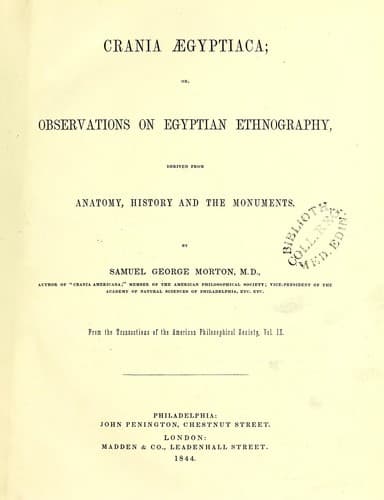
Crania Ægyptiaca: Or, Observations on Egyptian Ethnography Derived from Anatomy, History and the MonumentsMorton, Samuel George
History
Crania Ægyptiaca: Or, Observations on Egyptian Ethnography Derived from Anatomy, History and the Monuments
Morton, Samuel George
Craniology -- Egypt; Ethnology -- Egypt
In the annexed plates the reader will find seventy-four accurate
delineations of mummied heads, among which he will search in vain for
the alleged peculiarity of the Egyptian ear. It is equally absent in
the Pelasgic, Egyptian, Semitic, and Negroid forms: and yet the
Egyptians, on their monuments, bestowed it alike on the people of all
nations, of all epochs, and of every condition in life. See Plate XIV.
_Complexion._—On this point our evidence is, perhaps, less conclusive
than on most others connected with Egyptian ethnography. Yet, meagre
as it may seem, we cannot pass it by without a few remarks.
Herodotus, in the passage already cited, (p. 115,) speaks of the
colour of the Egyptians as if it were black; yet this is evidently a
relative, and not an absolute term. This remark applies, also, to the
hackneyed fable of the two black doves, who are said, in mythological
language, to have flown from Egypt, and established (at least one of
them) the oracle of Delphi. Here, again, Herodotus supposes that
because the doves were black, they must have represented Egyptian
personages. But the Greeks, observes Maurice, called every thing black
that related to Egypt, not excepting the river, the soil, and even the
country itself; whence the name [Greek: Ermochymios]—the black country
of Hermes.
Again, in reference to the statement of Herodotus, on which I have
already, perhaps, too largely commented, it may be well to give the
evidence of another eye-witness, that of Ptolemy the geographer, who
is believed to have been born in Egypt. He wrote in the second century
of our era, and his observations must consequently have been made
something more than five hundred years later than those of Herodotus.
His words are as follow:—“In corresponding situations on our side of
the equator, that is to say, under the tropic of Cancer, men have not
the colour of Ethiopians, nor are there elephants and rhinoceroses.
But a little south of this, the northern tropic, the people are
_moderately dark_, ([Greek: êrema tynchanousi melanes],) as those, for
example, who inhabit the thirty Schæni, (as far as Wady Halfa, in
Nubia,) above Syene. But in the country around Meroë they are already
sufficiently black, and _there we first meet with pure Negroes_.”[19]
Here is ample evidence to prove that the natural geographical position
of the Negroes was the same seventeen centuries since as it is now;
and for ages antecedent to Herodotus, the monuments are perfectly
conclusive on the same subject. I could, therefore, much more readily
believe that the historian had never been in Egypt at all,[20] than
admit the literal and unqualified interpretation of his words which
has been insisted on by some, and which would class the Egyptians with
the Negro race.
Public-domain text, read in full here on John Shaqi.
Reviews
Reviews
No reviews yet
Be the first to share your thoughts on this work.
Join the Discussion
Join the discussion
Sign in to leave a comment or review.
Sign InorCreate an account