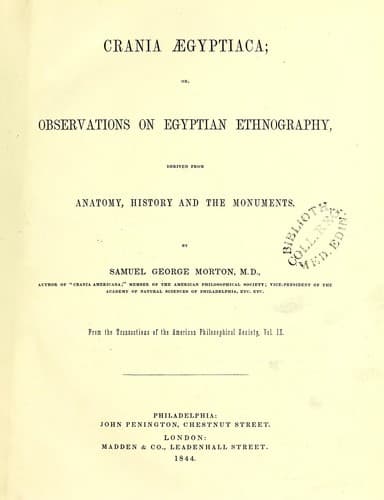
Crania Ægyptiaca: Or, Observations on Egyptian Ethnography Derived from Anatomy, History and the Monuments — John Shaqi
Crania Ægyptiaca: Or, Observations on Egyptian Ethnography Derived from Anatomy, History and the MonumentsMorton, Samuel George
History
Crania Ægyptiaca: Or, Observations on Egyptian Ethnography Derived from Anatomy, History and the Monuments
Morton, Samuel George
Craniology -- Egypt; Ethnology -- Egypt
On the monuments the Egyptians represent the men of their nation red,
the women yellow; which leads to the reasonable inference that the
common complexion was _dark_, in the same sense in which that term is
applicable to the Arabs and other southern Caucasian nations, and
varying, as among the modern Hindoos, from comparatively fair to a
dark and swarthy hue. “Two facts,” says Heeren, “are historically
demonstrated; one, that among the Egyptians themselves there was a
difference of colour; for individuals are expressly distinguished from
each other by being of a darker or lighter complexion: the other, that
the higher castes of warriors and priests, wherever they are
represented in colours, pertain to the fairer class.”
That the Ethiopians proper, or Meroïtes, were of a dark, and perhaps
very dark complexion, is more than probable; and among other facts in
support of this view, we find that the mother of Amunoph III., and
wife of Thotmes IV., who was a Meröite princess, is painted black on
the monuments. Thus the different complexion of the great divisions of
the Egyptian nation must sometimes have been blended, like their
physiognomical traits, even in the members of the royal family.
It is not, however, to be supposed that the Egyptians were really
_red_ men, as they are represented on the monuments. This colour, with
a symbolic signification, was conventionally adopted for the whole
nation, (with very rare exceptions,) from Meröe to Memphis. Thus,
also, the kings of the Greek and Roman dynasties are painted of the
same complexion.[21]
Professor Rosellini supposes the Egyptians to have been of a brown, or
reddish-brown colour, (rosso-fosco,) like the present inhabitants of
Nubia; but, with all deference to that illustrious archæologist, I
conceive that his remark is only applicable to the Austral-Egyptians
as a group, and not to the inhabitants of Egypt proper, except as a
partial result of that mixture of nations to which I have already
adverted, and which will be more fully inquired into hereafter.
The well known observation of Ammianus Marcellinus, “Homines Ægyptii
_plerique subfusculi_ sunt, et atrati,” is sufficiently descriptive,
and corresponds with other positive evidence, in relation to the great
mass of the people; and when the author subsequently tells us that the
Egyptians “blush and grow red,” we find it difficult to associate
these ideas with a black, or any approximation to a black skin.[22]
Public-domain text, read in full here on John Shaqi.
Reviews
Reviews
No reviews yet
Be the first to share your thoughts on this work.
Join the Discussion
Join the discussion
Sign in to leave a comment or review.
Sign InorCreate an account