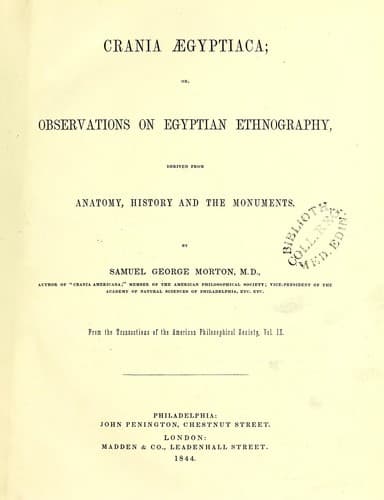
Crania Ægyptiaca: Or, Observations on Egyptian Ethnography Derived from Anatomy, History and the MonumentsMorton, Samuel George
History
Crania Ægyptiaca: Or, Observations on Egyptian Ethnography Derived from Anatomy, History and the Monuments
Morton, Samuel George
Craniology -- Egypt; Ethnology -- Egypt
To John Gliddon, Esq., United States consul at Alexandria, to the Rev.
George W. Bridges, and to M. E. Prisse, now in Egypt, I also take this
occasion to express my sincere acknowledgments for the practical zeal
with which they have aided my researches.
I have been enabled to make extensive and satisfactory comparisons by
means of nearly six hundred human crania, which form a part of my
private anatomical collection. The numbers in brackets refer to
corresponding numbers on the skulls themselves, and in my printed
catalogue; and will serve as a future test of the accuracy of my
observations, which, embracing as they do, such a multitude of details,
may require some revision and correction.
How far the following observations may assist in solving a problem
which, until lately, has been clothed in equal obscurity and interest,
is not for me to determine; but I trust they will at least, have the
effect of inciting others to researches of a similar nature.
---------------------
EGYPTIAN ETHNOGRAPHY.
“Vix quidem monitu opus est in tanta seculorum serie qua mos
cadavera balsamo condiendi in Ægypto solemnis fecit, inque tam
variorum ejus terræ dominorum et incolarum vicissitudine magnam
mumias intercedere debere variatatem tam quod ad conditurse variam
rationem et materiem; quam quod ad craniorum in mumiis gentilitiam
formam et speciem.”—BLUMENBACH, _Decad. Cran._ p. 12.
It was remarked fifty years ago by the learned Professor Blumenbach,
that a principal requisite for an inquiry such as we now propose, would
be “a very careful, technical examination of the skulls of mummies
hitherto met with, together with an accurate comparison of these skulls
with the monuments.” This is precisely the design I have in view in the
following memoir, which I therefore commence by an analysis of the
characters of all the crania now in my possession. These may be referred
to two of the great races of men, the CAUCASIAN and the NEGRO, although
there is a remarkable disparity in the number of each. The Caucasian
heads also vary so much among themselves as to present several different
types of this race, which may, perhaps, be appropriately grouped under
the following designations:—
CAUCASIAN RACE.
1. The [1]_Pelasgic Type_. In this division I place those heads which
present the finest conformation, as seen in the Caucasian nations of
western Asia, and middle and southern Europe. The Pelasgic lineaments
are familiar to us in the beautiful models of Grecian art, which are
remarkable for the volume of the head in comparison with that of the
face, the large facial angle, and the symmetry and delicacy of the whole
osteological structure. Plate III., Fig. 6, and Plate X., Fig. 8, are
among the many examples of this conformation.
Public-domain text, read in full here on John Shaqi.
Reviews
Reviews
No reviews yet
Be the first to share your thoughts on this work.
Join the Discussion
Join the discussion
Sign in to leave a comment or review.
Sign InorCreate an account