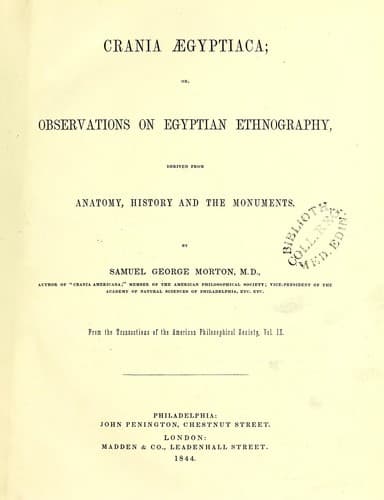
Crania Ægyptiaca: Or, Observations on Egyptian Ethnography Derived from Anatomy, History and the MonumentsMorton, Samuel George
History
Crania Ægyptiaca: Or, Observations on Egyptian Ethnography Derived from Anatomy, History and the Monuments
Morton, Samuel George
Craniology -- Egypt; Ethnology -- Egypt
The Hindoo head is also remarkable for its small size, its narrow
form, especially in front, and often, also, for the delicacy of the
osteological structure. The bones of the face, however, project more
than those of the European, and there is not unfrequently a manifest
eversion of the upper jaw. (B.) The nose is rather small, and the
bones are variously aquiline, straight, or moderately compressed. My
observations have been made on thirty-seven crania, for which I am
indebted to Drs. Burrough and Carson, of this city, and to Dr. Martin
and Mr. H. Piddington, of Calcutta. Of these, twenty-four are adult,
varying from eighteen to eighty years of age, and give an average
internal capacity of but eighty cubic inches; the largest head
measuring ninety cubic inches, the smallest only sixty-nine.[79] They
pertain, for the most part, to _low-caste_ Bengalees.
[Illustration]
It is in that mixed family of nations which I have called
Austral-Egyptian that we should expect to meet with the strongest
evidence of Hindoo lineage; and here, again, we can only institute
adequate comparisons by reference to the works of Champollion and
Rosellini. I observe the Hindoo style of features in several of the
royal effigies, and in none more decidedly than in the head of
Asharramon, as sculptured in the temple of Debod, in Nubia. The date
of this king has not yet been ascertained; but as he ruled over Meroë,
and not in Egypt, (probably in Ptolemaic times,) he may be regarded as
a good illustration of at least one modification of the
Austral-Egyptian type.
[Illustration]
Another set of features, but little different, however, from the
preceding, is seen among the middling class of Egyptians as pictured
on the monuments, and these I also refer to the Hindoo type. Take, for
example, the four annexed outlines, copied from a sculptured fragment
preserved in the museum of Turin. These effigies may be said to be
essentially Egyptian; but do they not forcibly remind us of the
Hindoo?[80] The mummied head figured Plate X., Fig. 6, has the same
general form and cast of features.
The Hindoos are also represented on the monuments as prisoners and
tribute-bearers to the kings. My drawing, Plate XIV., Fig. 21, is
copied from the “Grand Procession” of Thotmes IV. The man leads a
bear; an indication that he is of a foreign country, for there are no
bears indigenous to Africa. Moreover, the characters of the animal, as
delineated in Rosellini, are not unlike those of the celebrated
grotesque species of India called by naturalists _Ursus labiatus_,
which has been, in all ages, a favourite with Hindoo mountebanks. The
man himself has an aquiline and pointed nose, thin beard, receding
forehead, and comparatively fair complexion, which assimilate him to
some Indo-Semitic or Indo-Persian tribe.
[Illustration]
Public-domain text, read in full here on John Shaqi.
Reviews
Reviews
No reviews yet
Be the first to share your thoughts on this work.
Elsewhere in the archive
Join the Discussion
Join the discussion
Sign in to leave a comment or review.
Sign InorCreate an account