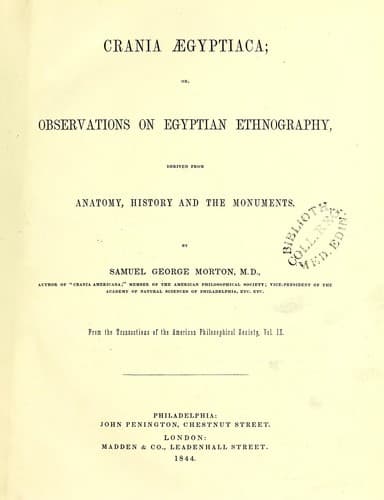
Crania Ægyptiaca: Or, Observations on Egyptian Ethnography Derived from Anatomy, History and the MonumentsMorton, Samuel George
History
Crania Ægyptiaca: Or, Observations on Egyptian Ethnography Derived from Anatomy, History and the Monuments
Morton, Samuel George
Craniology -- Egypt; Ethnology -- Egypt
In the same celebrated scene I notice another head of the same general
cast, but of a darker complexion and more delicate features, who
answers yet more accurately to the type of the northern Hindoos. He
wears a light dress and grass hat, and moreover leads an elephant, all
of which point to a warm climate. Mr. Hoskins remarks that “the
elephant must be from Ethiopia: if, therefore, they [the attendants]
are Scythians, as some suppose, they must be employed as slaves
bringing the produce of Ethiopia.” And he concludes by suggesting that
they may be white slaves of the latter country, sent as a present to
the Egyptian king. This appears to me to be an involved and
unsatisfactory explanation. The elephant, like the bear, is obviously
an Asiatic animal, (for the Egyptians made no use of the living native
species,) and it is evident that this group is merely typical of some
conquered Hindoo nation, or proximate and cognate tribe.
Winkelman, Blumenbach, and other authors, have also been struck with
these cranial resemblances; and certain physical analogies were
familiar to the writers of antiquity. They are especially recorded by
Strabo and Arrian, who compare the southern Hindoos to the Ethiopians,
and the northern Hindoos to the Egyptians. Various shades of
complexion, as we have remarked, were common to both countries,
together with a small stature and slender limbs.
History, mythology and the arts discover various additional analogies
between these venerable nations. Apis, the Egyptian bull, was the
symbol of Osiris; and the white bull is the animal on which Siva is
represented on the Indian pagodas: worship was bestowed alike on the
Ganges and the Nile; both nations paid homage to the sun and the
serpent; and even at the present time, the objects held in greatest
veneration by the Hindoos of the Vishnu sect are the ape, the monkey,
the bird called garruda, and the serpent capella. Among the symbols of
superstition in each are the sphinx, the lotus, the lingam, and the
cross. “The dog, sacred to Bhairava, a form of Siva, and the jackall
of Durga, remind us of the barking Anubis, the companion of Osiris.
The dogs of Yama, one of which was termed Cerbura, or spotted, and was
feigned to have three heads, corresponds remarkably, as Mr. Wilford
has observed, with the three-headed Cerberus, the dog of Pluto.”[81]
This affinity is also recognised in their almost exclusive vegetable
diet, and by the singular institution of castes. Analogies are,
moreover, traced in the architecture of the two nations, whether in
their monolithic temples and subterranean sanctuaries, or in the
statuary and minor decorations of their stupendous temples.[82]
Public-domain text, read in full here on John Shaqi.
Reviews
Reviews
No reviews yet
Be the first to share your thoughts on this work.
Elsewhere in the archive
Join the Discussion
Join the discussion
Sign in to leave a comment or review.
Sign InorCreate an account