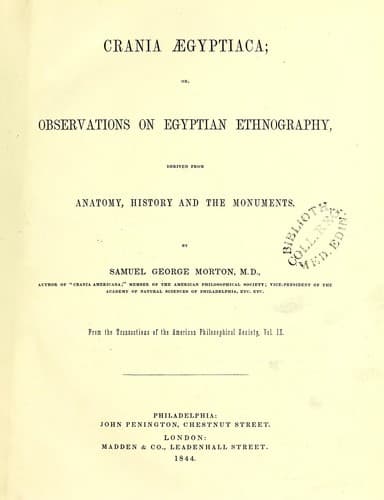
Crania Ægyptiaca: Or, Observations on Egyptian Ethnography Derived from Anatomy, History and the MonumentsMorton, Samuel George
History
Crania Ægyptiaca: Or, Observations on Egyptian Ethnography Derived from Anatomy, History and the Monuments
Morton, Samuel George
Craniology -- Egypt; Ethnology -- Egypt
It is moreover reasonable to suppose that even after the expulsion of
the Hykshos, multitudes of Egyptians would remain in Ethiopia,—that
country wherein whole generations of their ancestors had lived and
died; at the same time that great numbers of Meröites, influenced by a
variety of motives and especially by social alliances, would descend
the Nile into Egypt.
It is moreover evident that while the Egyptians became thus
fraternized with the nations of southern Asia, and the motley races of
the Upper Nile, the provinces of Lower Egypt would be overrun with the
Caucasian tribes of Europe and western Asia; for these, either as
cognate with the Hykshos or as allies in their service, must have been
in immense number to have conquered so populous a country, and
especially to have kept possession during so long a period. It is to
these events, then, that we attribute that blending of nations which
appears to have been coeval with the early ages of the Nilotic Family,
and which amply accounts for the ethnographic diversities every where
manifest on the monuments.
THE SECOND EPOCH is comprised in the Ethiopian Dynasty of three kings,
which lasted forty-four years, beginning B.C. 719.
These Meröite or Austral-Egyptian kings, during their intrusive
occupation of Egypt, would naturally, and indeed necessarily engage
the neighbouring tribes, and especially such as were hostile to Egypt,
as mercenary soldiers; and there are more than conjectural grounds for
believing that the Negroes themselves were thus employed. We are told
in the Sacred Writings (2 Chron. Chap. xii.) that when Shishak king of
Egypt, who is identical with Sheshonk of the monuments,—went up
against Jerusalem, he took with him “1200 chariots, and three-score
thousand horsemen: and the people were without number that came with
him out of Egypt; the Lubims, the Sukkiims and the Ethiopians.” Of
this multitude we may presume that the horsemen, and people in
chariots were part of the Egyptian army; the Lubims and Sukkiims are
by most commentators regarded as Libyans and Meröites, while, as the
Ethiopians are placed last on the list, and are designated in the
Hebrew original by the name of _Cush_, it is not unreasonable to
suppose that they were Negroes. This view is sustained by a passage in
Herodotus,[121] who states that in the army of Xerxes which invaded
Greece was a legion of _Western Ethiopians_, “who had hair more crisp
and curling than any other men.”[122] Now if the army of Xerxes
embraced a legion of African Negroes, it would not be remarkable if
the Egyptian troops should have been composed in part of the same
people; which, indeed, with respect to the Ethiopian dynasty, may be
assumed as a thing of course: for the Meröites would naturally avail
themselves of every expedient to establish their power by augmenting
the number of their exotic confederates, and by extending to them
Public-domain text, read in full here on John Shaqi.
Reviews
Reviews
No reviews yet
Be the first to share your thoughts on this work.
Elsewhere in the archive
Join the Discussion
Join the discussion
Sign in to leave a comment or review.
Sign InorCreate an account