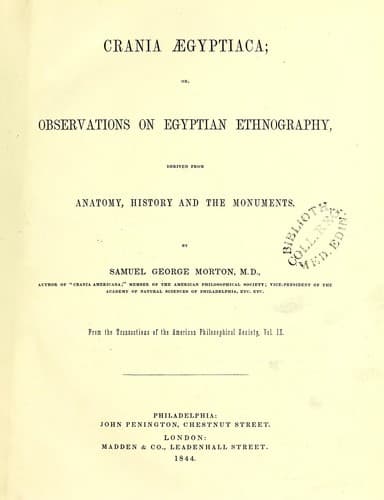
Crania Ægyptiaca: Or, Observations on Egyptian Ethnography Derived from Anatomy, History and the MonumentsMorton, Samuel George
History
Crania Ægyptiaca: Or, Observations on Egyptian Ethnography Derived from Anatomy, History and the Monuments
Morton, Samuel George
Craniology -- Egypt; Ethnology -- Egypt
“The phrase _a shepherd fed his flock_, is thus rendered in that
language:—_amiksa iksa thikhsi_. These words, moreover, constitute a
beautiful illustration of the genius of the language. In _amiksa_ we
have the formative particle _am_; and in _thikhsi_ there is the
feminine prefix _th_, a peculiarity alike of the Berber and the
Coptic. The prefixes and suffixes _t_, _th_, are Berber indications
throughout the whole extent of north Africa.” Vide also Hornemann,
Voyage, Vocab. p. 431.
Footnote 49:
In Jeremiah Cush and _Phut_ are names of African nations; while in
hieroglyphics Libya is called _Nephaiat_, the “country of the nine
bows.” The root of Nephaiat being _Phut_ (in Coptic a bow) connects
the Libyans with _Phut_, the son of Ham, (Gen. x. 6,) and confirms
the affiliation of the Libyans and Egyptians. See Gliddon, Anc.
Egypt, p. 25, 27, 41.
Footnote 50:
Sketches of Algiers, p. 91. Capt. Lyon’s observations are to the
same purpose. _Trav._ p. 109.—Denham and Clapperton, p. 73.
Footnote 51:
Denham and Clapperton, Introd. p. 67. To give some idea of the
number of the Tuaricks, these gentlemen mention that no less than
two thousand were executed at Sackatoo, in Houssa, on a single
occasion, for a predatory irruption into the territories of the
Negro sultan of that country.—_Journey from Kano to Sackatoo_, p.
107.
Footnote 52:
Ibid. p. 941, 213, 237, 263, 315.
Footnote 53:
Denham and Clapperton, p. 50. See also Hornemann, Voy. en Afrique,
p. 147.—All the Tibboo tribes appear to be Negroes modified by
intermixture with the Arabs and Berbers who surround them.
Footnote 54:
For the funereal rites of the Guanches as compared with those of the
Egyptians, see Bertholet, “Mémoires sur les Guanches,” in Mémoires
de la Société Ethnologique de Paris, Tome I.—See also Blumenbach,
Decad. Cran. Tab. XLII.
Footnote 55:
I use the word _Meroë_ in a comprehensive sense for all the ancient
civilized region south of Egypt.
Footnote 56:
Travels in Ethiopia, p. 329. Wilkinson, M. and C. Vol. I., Plate
LXII.
Footnote 57:
Idem. Plate X.
Footnote 58:
Travels in Ethiopia, Plate XIV. See also Cailliaud, Voy. à Meroë,
and Hoskins, Plate XXIX.
Footnote 59:
See Gliddon, Ancient Egypt, _passim_.
Footnote 60:
Modern Egyptians, Vol. II., p. 32.
Footnote 61:
Jomard, apud Mengin, Hist, de l’Egypte, p. 408. To this valuable
memoir the reader is referred for various additional analogies which
are unavoidably omitted on the present occasion.
Footnote 62:
“Le front haut et large, découvert et un pen fuyant.”—Jomard.
Footnote 63:
Public-domain text, read in full here on John Shaqi.
Reviews
Reviews
No reviews yet
Be the first to share your thoughts on this work.
Elsewhere in the archive
Join the Discussion
Join the discussion
Sign in to leave a comment or review.
Sign InorCreate an account