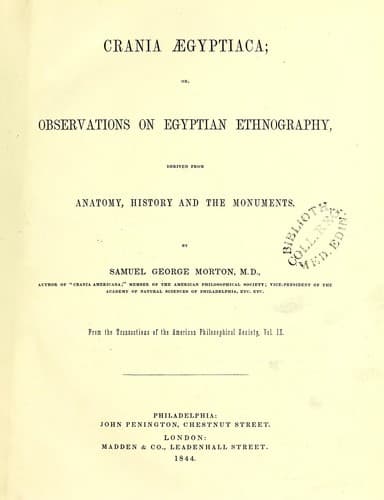
Crania Ægyptiaca: Or, Observations on Egyptian Ethnography Derived from Anatomy, History and the MonumentsMorton, Samuel George
History
Crania Ægyptiaca: Or, Observations on Egyptian Ethnography Derived from Anatomy, History and the Monuments
Morton, Samuel George
Craniology -- Egypt; Ethnology -- Egypt
In addition to the few remarks already made in reference to my use
of this term, I may observe that the Pelasgi were generally regarded
as the aboriginal inhabitants of Thessaly; but their warlike and
roving propensities led them to extend their migrations in various
directions, until we find it difficult, if not impossible, to
distinguish between them and the affiliated tribes of Dacians,
Macedonians and Thracians. At one period they ranged nearly the
whole country from Illyria to the Black Sea, and gave the name of
Pelasgia to all Greece; and, as every one knows, the Greeks or
Hellenes were their lineal descendants. See Prichard, Researches,
Vol. III., and Mrs. Gray’s History of Etruria, Vol. I., p. 86.
Footnote 64:
Cory, Frag. p. 114.
Footnote 65:
For the proofs that these effigies are really portraits of the
persons represented, the reader is referred to Rosellini’s chapter
entitled, “Iconografia dei Faraouni e dei re Greci de ’Egitto,” in
his _Monumenti_, M. S., Vol. II., p. 461. Portraits of the same king
sometimes differ very considerably from each other, I grant, but the
instances are few in comparison, and may have been intended to
designate different periods of life; nor are these differences
greater than we are accustomed to see in the physiognomy of modern
kings, as represented on their respective coins and medals. But even
if it could be demonstrated that the Nilotic paintings are not
portraits, it would not diminish their ethnographic value, for they
at least delineate the characteristic physiognomy of the Egyptians.
See also, Champollion, “Lettres écrites de l’Egypte et de la Nubie.”
Footnote 66:
Champollion, Monuments, Tom. I., Plate I. The annexed figure is
greatly enlarged from Champollion’s drawing. See also Rosellini, M.
R., Plate XXV., in which the _eye_ is wanting.
Footnote 67:
Champollion-Figéac, Egypte, p. 293.
Footnote 68:
Rosellini, M. C., Plate 33.
Footnote 69:
Antiquités, Tom. I., Plate 68.
Footnote 70:
Rosellini, M. C., Plate 13.
Footnote 71:
Idem. M. R., Plate 96.
Footnote 72:
Rosellini, M. R., Plate 158.
Footnote 73:
The Semitic race extended from the Mediterranean sea on the west to
the confines of Persia on the East, and doubtless possessed great
variety of feature and complexion. They derive their collective name
from Shem, “from whom, in the table of nations in the book of
Genesis, entitled Toldoth Beni Noah, many of them are declared to
have descended.” Prichard, Researches, II., p. 208, 2d ed. The
principal of these nations, adds Dr. Prichard, were those of Elam,
to the north-west of the Persian Gulf; the Assyrians; the Chasdim,
or Chaldeans, who are the ancestors of the Hebrews and Arabs; the
Lydians; and the Syrians, or people of Aram. They are also called,
collectively, Syro-Arabian nations.
Public-domain text, read in full here on John Shaqi.
Reviews
Reviews
No reviews yet
Be the first to share your thoughts on this work.
Elsewhere in the archive
Join the Discussion
Join the discussion
Sign in to leave a comment or review.
Sign InorCreate an account