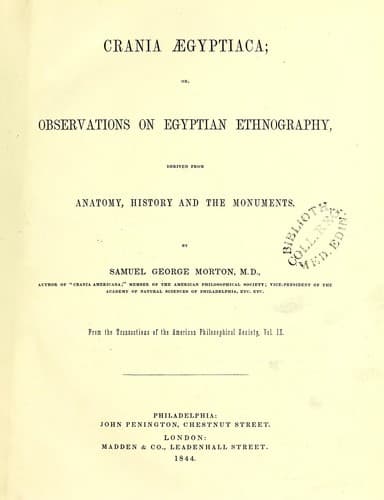
Crania Ægyptiaca: Or, Observations on Egyptian Ethnography Derived from Anatomy, History and the MonumentsMorton, Samuel George
History
Crania Ægyptiaca: Or, Observations on Egyptian Ethnography Derived from Anatomy, History and the Monuments
Morton, Samuel George
Craniology -- Egypt; Ethnology -- Egypt
The Jews were immensely numerous in Egypt during the Ptolemaic and
Roman epochs. _Vide_ Josephus, Book XII., chap. ii—Sharpe, Egypt
under the Romans, p. 13.
Footnote 74:
Letter to the Chev. Bunsen. See Wiseman’s Lectures on Science and
Revealed Religion, 2d edit., p. 62; and a note at the end of that
most learned and instructive work, “on the conformity between the
Semitic and the Indo-European grammatical forms.”
Footnote 75:
“Toutes leurs formes sout anguleuses,” says Denon; “leur barbe
courte et à mèches pointues.” Voyage en Egypte, I., p. 92.
Footnote 76:
Bedouins and Wahabys, p. 28.—Clot Bey, Aperçu generale de l’Egypte,
I., p. 161.
Footnote 77:
Edinburgh Review, Vol. LX., p. 297.
Footnote 78:
_Apud_ Mengin, Hist. de l’Egypte, III., p. 406.
Footnote 79:
I have stated, in my “Crania Americana,” that the Hindoos appear to
have the smallest heads of any existing people; and that in the Inca
Peruvians the brain was but a fraction larger. Later observations,
however, have led me to believe that the _Nigritos_, or aboriginal
Negro race of the Indian archipelago, present a nearly parallel
example.
Footnote 80:
Rosellini, M. S. H. II, p. 174, 238.
Footnote 81:
Prichard, Egyptian Mythology, p. 35.
Footnote 82:
Crania Americana, p. 37.
Footnote 83:
Bibliotheca, B. I., C. 2. “Khem, of whom Osiris is a form, is the
great deity corresponding to the Indian Siva; Phthah, of whom Horus
is another form, is the Indian Brahma; and Kneph is the counterpart
of Vishnu.” Cory, in Harapollo, Pref., p. x.
Footnote 84:
Trans. Roy. Soc. of Literature, I., p. 173. (London.)
Footnote 85:
Prichard, Researches, Vol. II., p. 218.
Footnote 86:
Ancient African Nations.—That the Indo-European race (of which the
Hindoos are a branch,) has been among the most enterprising and
widely distributed nations of the earth, is incontestably proved by
the prevalence of the Sanscrit tongue as an element of many
languages from Hindostan westward to the shores of Iceland, and
eastward to the Polynesian Isles.—Malte Brun, Geography, Vol. I., p.
660.
Footnote 87:
It is curious to observe that although the Hindoos in our day have
little intercourse with Nubia and the adjacent provinces, the
circumstance is owing to a want of those incentives to commerce
which existed in antiquity; but Burckhardt describes the remains of
Indian traffic as now seen in Mecca and Djidda, in Arabia, where the
Hindoos yet sell the manufactures and other productions of their own
country.—Travels in Arabia, p. 14, 119.
Footnote 88:
Public-domain text, read in full here on John Shaqi.
Reviews
Reviews
No reviews yet
Be the first to share your thoughts on this work.
Elsewhere in the archive
Join the Discussion
Join the discussion
Sign in to leave a comment or review.
Sign InorCreate an account