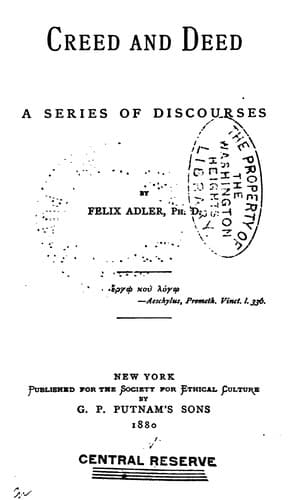
Creed and Deed: A Series of DiscoursesAdler, Felix
Religion
Creed and Deed: A Series of Discourses
Adler, Felix
Ethical culture movement; Ethics; Religion
Truly disinterestedness is the distinguishing mark of every high
endeavor. The pursuit of the artist is unselfish, the beauty he creates
is his reward. The toil of the scientist in the pursuit of abstract
truth is unselfish, the truth he sees is his reward. Why should we
hesitate to acknowledge in the domain of ethics, what we concede in the
realm of art and science? To say that unselfishness itself is only
the more refined expression of a selfish instinct, is to use the term
selfish with a double meaning, is a mere empty play on words. We have
the innate need of harmony in the moral relations; this is our glory,
and the stamp of the Divine upon our nature. We cannot demonstrate the
existence of disinterested motives, any more than we can demonstrate
that there is joy in the sunlight and freedom in the mountain breeze.
The fact that we _demand unselfishness_ in action alone assures us that
the standard of enlightened self-interest is false.
And indeed if we consult the opinions of men, where they are least
likely to be warped by sophistry, we shall find that disinterestedness
is the universal criterion by which moral worth is measured. If we
suspect the motive we condemn the act. If a person gives largely for
some object of public useful ness or charity, we do not permit the
munificence of the gift to deceive our judgment. Perhaps he is merely
desirous of vaunting his wealth, perhaps it is social standing he aims
at, perhaps he is covetous of fame. If these suspicions prove well
founded, the very men who accept his bounty will in their secret hearts
despise him, and by a certain revulsion of feeling we shall resent his
action all the more, because, not only is he destitute of honorable
purpose, but he has filched the fair front of virtue, and defiled the
laurel even in the wearing of it.
We do not even accord the name of goodness to that easy, amiable
sympathy which leads us to alleviate the sufferings of others, unless it
be guided by wise regard for their permanent welfare.
The tattered clothes, the haggard looks, the piteous pleading voice of
the pauper on the public highway may awaken our pity, but the system of
indiscriminate alms-giving is justly condemned as a weakness rather than
a virtue.
Public-domain text, read in full here on John Shaqi.
Reviews
Reviews
No reviews yet
Be the first to share your thoughts on this work.
Join the Discussion
Join the discussion
Sign in to leave a comment or review.
Sign InorCreate an account