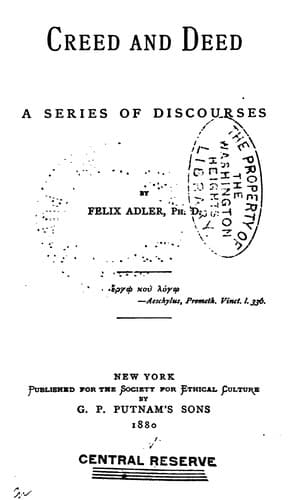
Creed and Deed: A Series of DiscoursesAdler, Felix
Religion
Creed and Deed: A Series of Discourses
Adler, Felix
Ethical culture movement; Ethics; Religion
On the other hand obedience to duty, when it involves pain and
self-abnegation, seems to rise in the general estimation. Clearly
because in this instance even the suspicion of interested motives is
removed, since hardship, injury in estate and happiness, and even the
possible loss of life, are among the foreseen consequences of the act.
It is for this reason that the Book of Martyrs has become the golden
book of mankind, and that the story of their lives never fails to fill
us with mingled sorrow, and admiration, and pride. They are monuments
on the field of history, milestones on the path of human progress. We
regard them and gain new courage and confidence in our better selves.
The blazing pyre on the Campo Fiore, whereon Giordano Bruno breathes his
last, becomes a beacon-light for the truth-seeker; the dying Socrates
still pours benignant peace over many a sufferer's couch; the Man of
sorrows, on Calvary, comforts the hearts of the Christian millions.
In the presence of these high examples the inadequacy of the selfish
standard becomes clearly apparent. We recognize what a sublime quality
that is in man which enables him, not only to triumph over torment and
suffering, but to devote his very self to destruction for the sake of
honor and truth. Freely must virtue be wooed, not for the dowry she may
bring; by loyal devotion to her for her own sake only, can she be won!
If thus it appears that not only is there nothing in the nature of
virtue to warrant a claim to reward, but that it is her very nature to
disclaim any reward, it will become plain that the problem, as stated
in the beginning, rests upon an entirely false foundation. That the
unrighteous and unprincipled should enjoy temporal happiness, does not
offend the law of justice. That you, my good sir, honest in all your
dealings, truthful in all your acts, should be unhappy, is greatly to
be deplored. Why evil and unhappiness should have been allowed at all to
enter a world created by an all good and all powerful Being may fairly
be asked. Why those who possess the treasure of a clear conscience
should not also possess the lesser goods of earth, is a question with
which morality is in no wise concerned.
Virtue can have no recompense, save as it is its own recompense, and
vice can receive no real punishment save as it is its own avenger.
The hope of immortality, in so far as it is based upon the supposed
necessity of righting in a future state what is here wrong, is therefore
untenable, for it is based upon the assumption of a wrong which exists
in the imagination merely. _And he who claims a reward because of his
virtue, has thereby forfeited his right to maintain the claim, since
that is not virtue, which looks for reward._
*****
Public-domain text, read in full here on John Shaqi.
Reviews
Reviews
No reviews yet
Be the first to share your thoughts on this work.
Join the Discussion
Join the discussion
Sign in to leave a comment or review.
Sign InorCreate an account