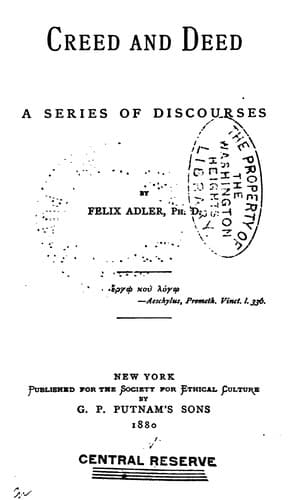
Creed and Deed: A Series of DiscoursesAdler, Felix
Religion
Creed and Deed: A Series of Discourses
Adler, Felix
Ethical culture movement; Ethics; Religion
We desire larger happiness than we can here achieve; but because we
desire a thing, are we therefore at all warranted in believing that
we shall obtain it? Is the course of the world's affairs such as to
encourage so flattering an hypothesis? Is not the fatality that so often
attends our best efforts in this life, an argument against, rather than
in favor of increasing felicity in another? We should assume a wiser
attitude as against fate. There are those who fret under disappointment,
and murmur and rebel as if they had been defrauded of a right; as if
they had entered into a compact with destiny to their advantage, as if
the myriad worlds moved through space for their especial good. This is
an insane spirit. We need something of the vim of stoicism to grapple
with the difficulties of life; we need to cultivate a larger patience;
an humble spirit prepared for every loss, and welcoming every hour
of joy as an unlooked for gain. There are a thousand pleasures too in
little things which we, with the petulance of children, daily spurn,
because we cannot have all we ask for. In every stone there is
instruction, in every varying aspect of the sky there is beauty,
wherever men congregate and commune, lessons of wisdom are revealed to
the observer. The movement of everlasting laws quivers in the meanest
trifles, and the eternities, thinly veiled, look out upon us with their
solemn gaze from every passing mask of time. These let us study; art
will help us; science will open to us a wondrous chain of workings which
the mind cannot exhaust, and active exertions for the common weal will
give a generous glow to our lives, and still the unquiet yearnings which
we may never entirely set at rest. You have seen how the flowers grow,
how that many seeds are scattered and but few take root; how the germ
slowly and with difficulty develops. The rain waters it, the warm
sunbeam fosters it; storms sweeping over the earth, may crush it while
it is still a young and tender shoot. At last, sometimes after years of
preparation, it buds and opens and blooms and becomes a delight and a
glory, a fount of fragrance, a crown of beauty. A few days pass and
it droops; what the long process of time has slowly created, a single
moment may suffice to destroy; and yet though its time was brief, the
flower fulfilled its nature only in that passing bloom; all the previous
stages of its existence had a meaning only as they led up to this, the
final revelation of its purpose.
The bloom of human life is morality; whatever else we may possess,
health, and wealth, power, grace, knowledge, have a value only as they
lead up to this; have a meaning only as they make this possible. Nor
should we complain that the blight of death so quickly withers what the
course of threescore years has scarce sufficed to produce. In the hour
of our destruction, we will lift up our hearts in triumph--we have
blossomed! We have blossomed!
Public-domain text, read in full here on John Shaqi.
Reviews
Reviews
No reviews yet
Be the first to share your thoughts on this work.
Join the Discussion
Join the discussion
Sign in to leave a comment or review.
Sign InorCreate an account