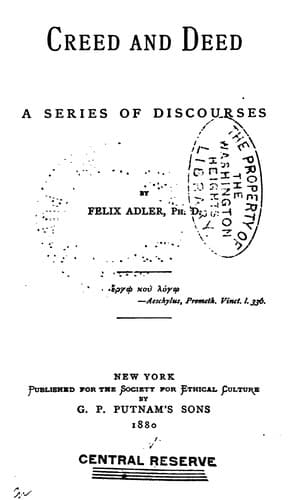
Creed and Deed: A Series of Discourses — John Shaqi
Creed and Deed: A Series of DiscoursesAdler, Felix
Religion
Creed and Deed: A Series of Discourses
Adler, Felix
Ethical culture movement; Ethics; Religion
But it will be said, that the flower when it is wilted and withered
here, may be transplanted to fairer regions; that the soul may take
on new organs, when it has abandoned its earthly habitation, and in a
series of transformations of which, it is true, we can form no definite
conception, may enter afresh upon its struggles for worthiness in other
spheres. This is, indeed, the loftiest expression which the hope of
immortality has found. Unlike the arguments previously considered, it
is unalloyed by any selfish motive, is founded upon a really exalted
sentiment, and it is Love and Virtue themselves that here take up the
strain, and sing us their animating song of ceaseless progress toward
the good. The argument in this shape, involves the further question
whether the existence of an independent and indestructible soul is
assured, and upon this point the whole problem of immortality finally
hinges.
The question whether what we are accustomed to call the soul is a
distinct and indivisible entity, or merely the result of material
processes, has divided mankind for more than two thousand years, and
some of the ablest thinkers have ranged themselves on either side. As
early as the fifth century B. C. the philosopher Democritus propounded
materialistic doctrines among the Greeks. According to him, the soul is
a combination of smooth, round, polished and moving atoms, and to the
motions of these atoms the phenomena of life are to be ascribed.
Among the Romans, Lucretius advanced similar views. He took particular
pains to combat the "vulgar fear of death," protesting that the prospect
of dissolution would lose its terrors, did we not foolishly imagine
ourselves conscious of being dead, forgetting that death implies the
entire cessation of consciousness. The followers of materialistic
opinions among the ancients, were not a few. But during the ascendancy
of the Christian Church, these opinions retired into the background,
until in the seventeenth and eighteenth centuries, they were revived by
such men as Gassendi and La Mettrie, and others. In modern times they
have been widely spread.
The list of names on the opposite side is headed by Socrates, Plato,
Aristotle, and embraces the great majority of writers and public
teachers, down to the present day.
It may appear strange that when the belief in immortality had once
become current, men should have been tempted to forego its pleasing
prospects, and even, with a certain vehemence, to urge their sceptical
views upon others. Let us consider for a moment, what it was that
induced the materialists to assume their position. The observed
correspondence between mental and physical phenomena doubtless led them
in the first instance to adopt their peculiar views.
Public-domain text, read in full here on John Shaqi.
Reviews
Reviews
No reviews yet
Be the first to share your thoughts on this work.
Join the Discussion
Join the discussion
Sign in to leave a comment or review.
Sign InorCreate an account