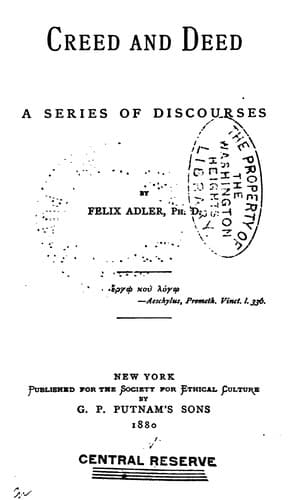
Creed and Deed: A Series of DiscoursesAdler, Felix
Religion
Creed and Deed: A Series of Discourses
Adler, Felix
Ethical culture movement; Ethics; Religion
It is true, the considerations I have enumerated are based upon a mere
surface view of things, but the more accurate methods of science seem,
at first sight, to confirm the general conclusions to which they lead.
On this point, it would be well to dwell for a moment. John Stuart Mill
acknowledges that "the evidence is well-nigh complete that all thought
and feeling has some action of the bodily organism for its immediate
coincident and accompaniment, and that the specific variations, and
especially the different degrees of complication of the nervous and
cerebral organism, correspond to differences in the development of our
mental faculties."
The prodigious difficulties in the way of the study of the brain may
long retard the progress of the investigator, but for the purposes of
our argument we are at liberty to assume whatever is within the limits
of possible achievement. We may suppose that physiology will succeed
so far that the brain will be accurately and completely mapped out, and
that the motions of the atoms upon which the thousand varying modes of
thought and feeling depend, will be known and measured. In anticipating
such results, we have reached the utmost tenable position of
materialism.
But now to our surprise we discover that all this being allowed, the
ultimate question, what is soul, remains still unsolved and as insoluble
as ever. The unvarying coincidence of certain modes of soul with certain
material processes may be within the range of proof, but what cannot be
proven is, that these material processes explain the psychic phenomena.
If it is urged that the same difficulty presents itself in the
explanation of the most ordinary occurrences, this objection is based
upon a misapprehension of the point at issue.
The scientist cannot show why heat should be convertible into motion,
but how it is thus transformed is easy to demonstrate, and the exact
mechanical equivalent of heat has been calculated. But how certain
motions of atoms in the brain should generate, not heat, but
consciousness, but thought and love, is past all conception. There are
here two different orders of facts, having no common principle to which
they could both be reduced. There is an impassable gulf between them
which can in nowise be bridged over.
Nor would it avail us to endow the atom itself with the promise and
potency of intellect; we should thereby throw back the issue a step
further, and disguise the problem whose existence it were better to
plainly acknowledge. The broad fact of consciousness therefore remains
unexplained and inexplicable as before. Arrived at this limit, science
itself pauses and refuses to pass further.
Public-domain text, read in full here on John Shaqi.
Reviews
Reviews
No reviews yet
Be the first to share your thoughts on this work.
Join the Discussion
Join the discussion
Sign in to leave a comment or review.
Sign InorCreate an account