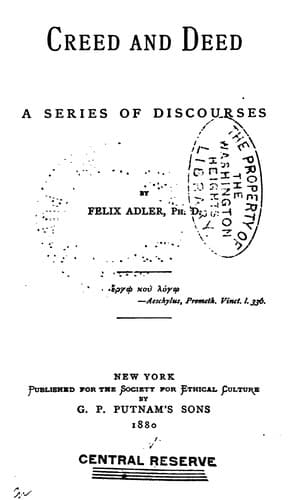
Creed and Deed: A Series of Discourses — John Shaqi
Creed and Deed: A Series of DiscoursesAdler, Felix
Religion
Creed and Deed: A Series of Discourses
Adler, Felix
Ethical culture movement; Ethics; Religion
Some of the leading naturalists of our day have lately expressed
themselves clearly and tersely in this sense. The eminent physiologist
Dubois Rey-mond denies that the connection between certain motions of
certain atoms in the brain, and what he calls, the primal, undefinable
and undeniable facts of consciousness, is at all conceivable.
Professor Tyndall in his address on "The scope and limits of Scientific
Materialism," explains his views with similar precision.
Were our minds so expanded, strengthened and illuminated as to enable
us to see and feel the very molecules of the brain; were we capable of
following all their motions, all their groupings, all their electric
discharges, if such there be; and were we intimately acquainted with the
corresponding states of thought and feeling, we should be as far as
ever from the solution of the problem. How are these physical processes
connected by and with the facts of consciousness? I do not think the
materialist is entitled to say that his molecular groupings and
his molecular motions explain everything, in reality they explain
nothing.... The problem of body and soul is as insoluble in its modern
form as it was in the pre-scientific ages.
Now since it is impossible to demonstrate that the powers of mind are a
product of matter, the possibility undoubtedly remains that these powers
may continue to exist even after their connection with the physical
organism has been dissolved. If all the arguments that are commonly
adduced in support of the doctrine of a future life fall short of their
object, it is but just to add that every argument to the contrary is
equally devoid of foundation. The doctrine of immortality cannot be
disproved. Of the nature of soul we are in absolute ignorance we know
nothing; what is more, we can know nothing At this point we touch the
utmost boundary of human reason, and must be content to write mystery of
mysteries.
Public-domain text, read in full here on John Shaqi.
Reviews
Reviews
No reviews yet
Be the first to share your thoughts on this work.
Join the Discussion
Join the discussion
Sign in to leave a comment or review.
Sign InorCreate an account