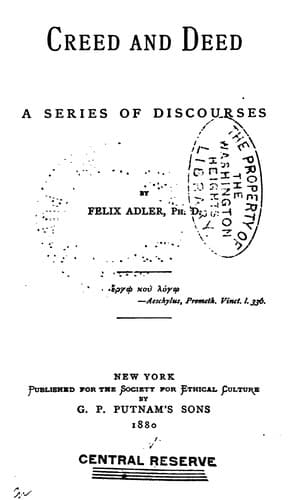
Creed and Deed: A Series of DiscoursesAdler, Felix
Religion
Creed and Deed: A Series of Discourses
Adler, Felix
Ethical culture movement; Ethics; Religion
Furthermore, it follows from what we have said that the belief in
immortality should not be inculcated as a dogma in our schools of
religion, and above all that the dictates of the moral law should in no
wise be made to depend upon it for their sanction. The moral law is
the common ground upon which all religious and in fact all true men may
meet. It is the one basis of union that remains to us amid the clashing
antagonisms of the sects. While dogma is by its nature, open to attack,
and its acceptance at all times a matter of choice, the principles of
morality have a right to demand implicit obedience, and should rest as
everlasting verities in the human heart. Let us reflect well before we
imperil the latter by the undue prominence which we give the former. It
is not needful to impart to a child the whole truth, but what it learns
should be wholly true, and nothing should be taught it as a fundamental
fact which it can ever in after years be led to call in question. How
often has it occurred that when the riper reason of the man has rejected
the tenets of the church in which he was educated, he has been tempted
to cast aside all the religious teachings of his youth, the moral with
the rest, as idle fable and deceit.
And lastly, friends, as we do not, cannot know, it is presumably wise
that we should not know. The vanity of all our efforts to grasp the
infinite, should teach us that on this island of time whereon we live,
lies our work. In its joys we may freely take delight; for its woes we
should reserve our sympathies, and in laboring to advance the progress
of the good we must find our satisfaction.
Public-domain text, read in full here on John Shaqi.
Reviews
Reviews
No reviews yet
Be the first to share your thoughts on this work.
Join the Discussion
Join the discussion
Sign in to leave a comment or review.
Sign InorCreate an account