Creed and Deed: A Series of Discourses — John Shaqi
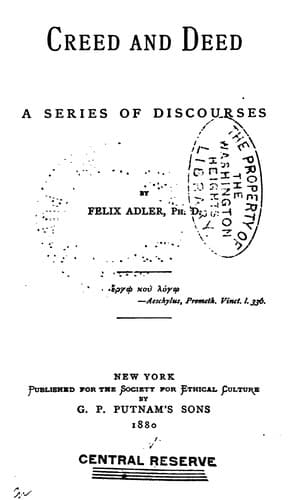
Creed and Deed: A Series of DiscoursesAdler, Felix
Religion
Creed and Deed: A Series of Discourses
Adler, Felix
Ethical culture movement; Ethics; Religion
Before closing this subject however let us recall vividly to our minds
that the desire for continuance after death is capable of the most
noble expression, and of supplying us with wholesome consolation and
inspiriting motives to action. The individual passes, but the race
lives! There is a law in nature that no force is ever lost. The thousand
varying forms that ebb and flow around us are various only to our feeble
vision. At the core they are one, transmuted, yet the same, changing
yet changeless, perishing to rise anew. The law of the conservation of
energy holds good throughout the entire domain of matter. And such a law
too obtains in our spiritual life. The law of the conservation of moral
energy is no less an abiding truth; we are not dust merely, that returns
to dust; we are not summer flies that bask in the sunshine of the
passing day; we are not bounded in our influence by the narrow tenure
of our years. Say not when the sod has closed above those who have been
dear to you that all is gone. Say not that the grace and loveliness, and
wisdom that once dwelt within the pallid form is breathed away like
a hollow wind. Nor yet stand idly gazing upon the cloud-land of the
future, watching if you can trace perchance their shadowy lineaments
fading into the dimness of untried worlds. The dead are not dead if we
have loved them truly. In our own lives we give them immortality. Let us
arise and take up the work they have left unfinished, and preserve the
treasures they have won, and round out the circuit of their being to the
fullness of an ampler orbit in our own.
All the good that was in them lives in you, the germ and nucleus of
the better that shall be. All the evil that inhered in them shall be
cleansed away in you and your virtues shall be the atonement for their
sins. Thus shall the fathers live in the children, and from generation
to generation the bond that connects the past with the future remains
unbroken. They that have left you are not afar; their presence is near
and real, a silent and august companionship. In the still hours of
meditation; under the starlit night, in the stress of action, in trials
and temptations, you will hear their voices whispering words of cheer or
warning, and your deeds are their deeds and your lives are their lives.
So does the light of other days still shine in the bright hued flowers
that clothe our fields; so do they who are long since gathered into
the silent city of the dead still move about our houses, distributing
kindness and nobleness among our lives. So does the toll of the funeral
bell become an alarum to rouse us to more active effort and to the
nobler service of mankind.
II. RELIGION.
Public-domain text, read in full here on John Shaqi.
Reviews
Reviews
No reviews yet
Be the first to share your thoughts on this work.
Join the Discussion
Join the discussion
Sign in to leave a comment or review.
Sign InorCreate an account