Creed and Deed: A Series of Discourses — John Shaqi
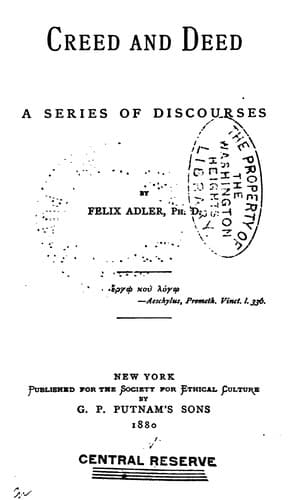
Creed and Deed: A Series of DiscoursesAdler, Felix
Religion
Creed and Deed: A Series of Discourses
Adler, Felix
Ethical culture movement; Ethics; Religion
Another mode of substitution was to give a part for the whole. Some one
member of the body was mutilated or curtailed in order to indicate that
the person's life was in reality forfeit to the god. Among certain of
the aboriginal tribes of America, the youth, on reaching the years of
maturity, was forced to place his hand upon a buffalo's skull, and one
or more joints of the finger were then cut off and dedicated to the
great spirit. There were other modes of mutilation of which I dare not
speak, but I will briefly add that the so-called rite of the covenant,
which is practised among the Jews even at the present day, rose in
exactly the same manner. Of course the original signification of the
custom has been forgotten and a purely symbolical mean-ing has been
attached to it. Nevertheless, its continuance is a disgrace to religion.
The grounds of sanity on which it is urged, are not in themselves
tenable, and if they were, religion would have no concern with them. It
is but a fresh instance of the stubborn vitality which seems to inhere
in the hoary superstitions of the past.
Occasionally, when a whole people was threatened with destruction, some
prominent and beloved individual was selected for sacrifice, in order
that by his death he might save the rest. The same feature was also
introduced into the legends of the gods. Philo tells us that the great
God El whom the Hebrews and Phoenicians worshiped, once descended to
earth, and became a king. This El was the supreme deity. He had an only
son whom he loved. One day when great dangers threatened his people,
the god determined to sacrifice his only begotten (--Greek--) son and
to redeem his people: and year by year thereafter a solemn festival was
celebrated in Phoenicia in honor of that great sacrifice.
The religion of force has left its dark traces in the history of
mankind. Even the higher religions accepted, while they spiritualized,
its degrading conceptions into their systems. Slowly only and with the
general spread of intelligence and morality, can we hope that its last
vestiges will be purged from the minds of men.
Public-domain text, read in full here on John Shaqi.
Reviews
Reviews
No reviews yet
Be the first to share your thoughts on this work.
Join the Discussion
Join the discussion
Sign in to leave a comment or review.
Sign InorCreate an account