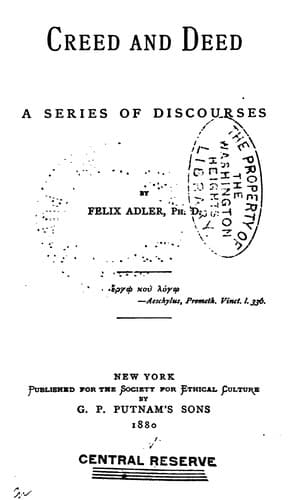
Creed and Deed: A Series of DiscoursesAdler, Felix
Religion
Creed and Deed: A Series of Discourses
Adler, Felix
Ethical culture movement; Ethics; Religion
Vastness is an element of the sublime. In the religious conceptions of
the Hindoos we find it illustrated. It entered alike into the system of
the Brahmin and of the Buddhist, and determined their tone and quality.
A certain fondness for the gigantic, is peculiar to Hindoo character.
Witness the almost boundless periods of their ancient chronology;
the colossal forms with which the remains of their monuments and
architecture abound. A great Aryan nation having advanced from the
waters of the Indus to the shores of the sacred Ganges and having
subdued the natives by the force of superior numbers or bravery,
had learned to forget the active pursuits of war, and yielded to the
lassitude engendered by the climate of their new settlements. Around
them they beheld a rich and luxuriant vegetation; birds of rare and
many colored plumage, stately trees rising from interminable jungles.
Ravishing perfumes lulled their senses as they reposed in the shade of
these fairy-like forests. It was a land suited to dreamy contemplation.
Here the philosophic priests might dwell upon the vastness of the
Universal, and the imagination bewildered by the ever shifting phenomena
of the scene might well seek some principle of unity which could connect
and explain the whole. Brahma was the name they gave to the pervading
Spirit of All things. From Brahma the entire order of existence has
emanated; the elements of material things, plants, birds, beasts and
men. The lower castes came forth first and are nearest the brutes;
the castes of free-born workmen, and of warriors next, the priests and
saints last, in whom the world's soul found its loftiest expression.
To Brahma all things must return. Passing through an endless series of
transformations, and paying in the long and painful interval the penalty
of every crime it has committed, the migrating spirit of man is led back
at last to its primal source, and is resolved in the Brahma whence it
arose. The connection between individual and universal life was thus
kept constantly in view. The soul in the course of its wanderings might
pass through every conceivable mode of existence; might assume the
shape of creeping plants and worms, and wild animals; might rise to the
possession of miraculous powers in the heavens of the Rishis, while its
final destiny was to be reunited with the One and All.
Public-domain text, read in full here on John Shaqi.
Reviews
Reviews
No reviews yet
Be the first to share your thoughts on this work.
Join the Discussion
Join the discussion
Sign in to leave a comment or review.
Sign InorCreate an account