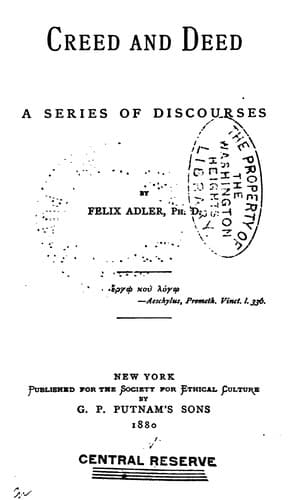
Creed and Deed: A Series of DiscoursesAdler, Felix
Religion
Creed and Deed: A Series of Discourses
Adler, Felix
Ethical culture movement; Ethics; Religion
In approaching our subject we are first confronted by the argument
from the common consent of mankind. Like the belief in God, the hope
of immortality is said to be implanted in every human heart, and the
experience of travellers is cited to show that even the most barbarous
races have given it expression in some form, however crude. Aside from
the fact that the statement, as it stands, is somewhat exaggerated, we
will admit that the belief in a future state is widely current among
savage tribes. But the value of this testimony becomes extremely
doubtful on closer inspection. A brief account of the origin of the
conception of soul among our primitive ancestors, will make this plain.
If we observe a child in its sleep, some half articulate word, some cry
or gesture occasionally reveals to us the vividness of the dreams with
which the little brain is teeming. It is hardly doubtful that the child
mistakes the visions of its dream for actual occurrences, and attaches
the same reality to these miasmas of the stagnant night as to the
clear prospects of daylight reason. Even the adult sometimes finds it
difficult to clear his brain of the fancies which occupied it in the
hours of sleep. And the test of large experience can alone enable him to
distinguish between fact and phantom. I call attention to these facts,
because the phenomena of sleep and dreams seem to offer a satisfactory
clue to the naive theories of the lower races concerning death and the
after life. The savage indeed is the veritable child-man. His ardent
emotions, his crude logic, the eagerness with which he questions the how
and wherefore of nature, and the comparative ease with which his simple
understanding accepts the most fanciful solutions, all combine to place
him on the level of the child.
Public-domain text, read in full here on John Shaqi.
Reviews
Reviews
No reviews yet
Be the first to share your thoughts on this work.
Join the Discussion
Join the discussion
Sign in to leave a comment or review.
Sign InorCreate an account