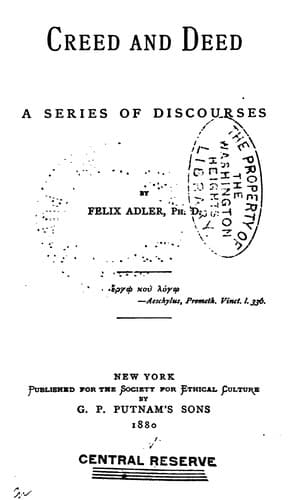
Creed and Deed: A Series of DiscoursesAdler, Felix
Religion
Creed and Deed: A Series of Discourses
Adler, Felix
Ethical culture movement; Ethics; Religion
Aware that the body in sleep is at rest, while at the same time the
sleeper is conscious of acting and suffering, visiting distant regions
perhaps, conversing with friends, engaging in battle with enemies, the
savage reasoned that there must be a man within the man, as it were,--an
airy counterfeit of man which leaves its grosser tenement in the night,
and in the course of its wanderings experiences whatever the fortunes of
the dream may chance to be. Instances are related where the body was
prematurely disturbed, the inner man was prevented from returning to his
envelope, and death resulted. The shadow cast by the human figure, an
attenuated image of man, connected with the body and yet distinct from
it, afforded a curious confirmation of this artless theory. The Basutos*
affirm that a person having on one occasion incautiously approached the
bank of a river, his shadow was seized by a crocodile, and he died in
consequence. The story of shadowless or soulless men has been made
familiar to modern literature by Chamisso's well known tale. The
spectral man who severs his connection with the body during sleep,
remains concealed within it during the hours of waking, and in this
manner, the idea of a human soul as distinct from the body, takes its
rise.** It is easy to see how by extending the analogy, what we call
death must have appeared as only another form of sleep, and how the
theory of dreams gave rise to a belief in the continuance of life beyond
the grave. That sleep and death are twin brothers, was to the primitive
man more than mere metaphor. As in sleep, so in death, the body is at
rest, but as in sleep, so also in death, a shade was supposed to go
forth capable of acting and suffering, and yearning to return to its
former condition. The apparitions of the deceased seen at night by the
friends they had left behind, were taken to be real visitations, and
corroborated the assumption of the continued existence of the departed.
The ghosts of the dead were dreaming phantoms, debarred from permanently
returning to their abandoned bodies.
* The dream theory seems to be the one generally adopted by
writers on primitive culture. For an extended account of
this subject vide the works of Tylor, Lubbock and Bastian,
from which the illustrations given in the text are taken.
** Peter Schlemihl.
*** The soul was believed to be corporeal in nature, only
more vague and shadowy than the framework of the body, and
distinguished by greater swiftness of locomotion.
Public-domain text, read in full here on John Shaqi.
Reviews
Reviews
No reviews yet
Be the first to share your thoughts on this work.
Join the Discussion
Join the discussion
Sign in to leave a comment or review.
Sign InorCreate an account