Creed and Deed: A Series of Discourses — John Shaqi
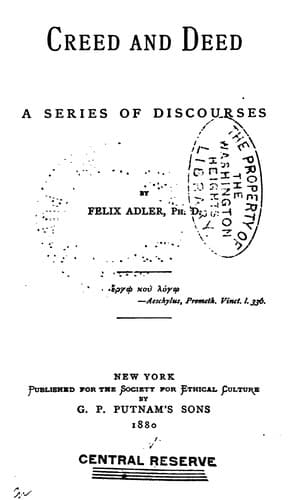
Creed and Deed: A Series of DiscoursesAdler, Felix
Religion
Creed and Deed: A Series of Discourses
Adler, Felix
Ethical culture movement; Ethics; Religion
The Hebrews were the first to lend to the moral ideas a controlling
influence in the sphere of religion. Let me attempt to briefly sketch
the origin of Monotheism amongst them, as numerous considerations
elsewhere recited in detail, have led me to conceive of it. The
religions of the Semitic nations who surrounded ancient Israel were
intensely emotional in character, and their gods were gods of pleasure
and pain. In the temples unbounded license alternated with self
sacrificing asceticism. The lewd rites of the goddess of love must
be regarded as typical of the one; the slaughter of sons in honor of
Moloch, of the other. Now the Hebrews have been distinguished for the
purity of their home life from a very early period of their history. The
high value which they set on male offspring, the jealous vigilance with
which they guarded the virtue of their women are alike illustrated in
the narratives of the Bible. The more gifted and noble minded among
them, beholding their domestic feelings outraged by the prevailing
religions, rebelled against the gross conceptions of idolatry. How could
they offer up their beloved sons for sacrifice, how could they give
over their wives and daughters to shame? The controlling force of their
character determined the doctrines of their creed. Judaism became, so to
speak, a family religion. Jehovah is conceived of as the husband of
the people. Israel shall be his true and loyal spouse, the children
of Israel are His children. The image of Jehovah is that of the ideal
patriarch. Like the patriarch, he is the head of the spiritual family
of man. Like the patriarch in ancient times, he is the lawgiver and
the judge; He is the guardian of domestic purity. The word for false
religion in Hebrew signifies fornication. "Contend against your mother,"
says Jehovah, "for I am not her spouse, nor she my wife." "My people
lust after false gods, for the spirit of impurity has seduced them." And
the day of the triumph of the true religion is thus predicted: "On that
day thou shalt not call me any more my Baal, (paramour) but thou shalt
call me my husband, and I shall wed thee in justice, etc." Thus the idea
of Jehovah sprang from the soil of the family, and the conception of a
divine father in heaven was derived from the analogy of the noblest of
moral institutions on earth. The spiritual God of the Hebrews was the
personification of the moral Ideal.
Public-domain text, read in full here on John Shaqi.
Reviews
Reviews
No reviews yet
Be the first to share your thoughts on this work.
Join the Discussion
Join the discussion
Sign in to leave a comment or review.
Sign InorCreate an account