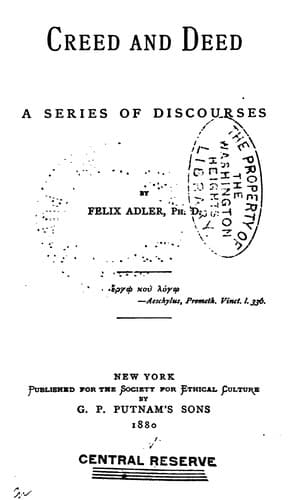
Creed and Deed: A Series of DiscoursesAdler, Felix
Religion
Creed and Deed: A Series of Discourses
Adler, Felix
Ethical culture movement; Ethics; Religion
Like his relations to the chosen people and to mankind in general,
the relations of the Deity to the external world were described in
accordance with the demands of the Ethical Law. Two things morality
insists upon; first, that the natural in its coarser acceptation shall
be subordinate to the moral. Secondly, that in the scale of values
itself shall occupy the highest rank, and that the purpose human life on
earth can only be a moral purpose. As the mechanism of nature is not of
itself calculated to harmonize with the purposes of spirit, it behooves
that the spiritual God shall possess a power over matter adequate to
enforce the claims of the moral ideal, such power as only the creator
can exert over his creatures. Hence the doctrine of the creation. And
again the state of perfection to which the human heart aspires can only
be attained through the instrumentality of supreme wisdom, power and
love, in a millennial age when the scheme of the universe will be
perfected in the reign of absolute justice and peace. Hence the doctrine
of the Messiah. Both doctrines are the typical expression of a moral
need.
In the opening of Genesis we read a description of the making of the
world. All was wild vast chaos, and darkness brooded over the abyss,
when the Spirit of Jehovah breathed on the waters; a single word of
command and light penetrated the gloom, the waters divided, the great
luminaries started forth on their course; the earth clothed herself in
verdure, and the forms of living beings sprang into existence. The words
"God saw everything he had made and behold it was very good," contain
the gist of the narrative. In Zephaniah and Isaiah we read: "On that day
I will turn to the people a pure language that they may all call upon
the name of the Lord to serve him with one consent." "No one shall then
do evil, no one hurt in all my holy mountain, for the earth shall be
full of the knowledge of God as the waters cover the sea."
These visions are not true in the sense of historical occurrences past
or future. That the world was ever created out of nothing, what human
understanding can conceive of it? That a time will come when society
shall be so transformed that the pure language of love alone shall be
spoken, who that is instructed in the failings of our finite nature can
credit it? They are true in the sense of ideals; true, with the truth
of poetry, bodying forth in concrete shape the universal yearnings of
mankind.
Public-domain text, read in full here on John Shaqi.
Reviews
Reviews
No reviews yet
Be the first to share your thoughts on this work.
Join the Discussion
Join the discussion
Sign in to leave a comment or review.
Sign InorCreate an account