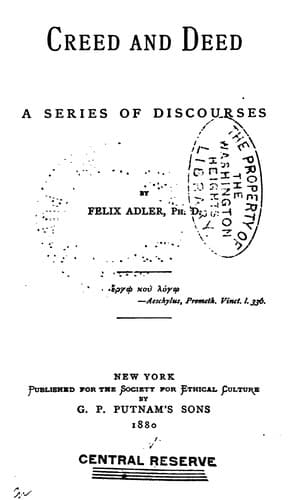
Creed and Deed: A Series of DiscoursesAdler, Felix
Religion
Creed and Deed: A Series of Discourses
Adler, Felix
Ethical culture movement; Ethics; Religion
From the back-ground of the old Ideal stands out in bold relief the new.
It is the reverse of supernatural; if it takes pride in anything, it is
in marking a return to nature. Trammels of the flesh, contamination of the
body? There is nothing it tells us in itself contaminating. The body is
not alien to the mind, it is the seed plot from which mind flowers out
in every part. Regard the form of man, observe the quick play of the
features, the expressive smile, the speaking glance, every attitude,
every gesture full of meaning, the whole body irradiated as it were,
with the indwelling intelligence. And so the passions too which we are
wont to associate with our corporeal nature are but the rough material
from which the artist soul behind them fashions its immortal types of
beauty and of holiness. There is a graceless innuendo in the term nature,
as of something hard, gross, material. In truth, nature is the subtlest,
most ethereal presence of which we catch a gleam only at rare intervals,
the reflex of a hidden light that glimmers through the facts and motions
of the world. Take the nature of water for instance. Is it in the
hydrogen, in the oxygen, in the single atom? Not there, yet there!
somewhere hovering, imponderous, elusive. It comes nighest to the senses
when the atoms act and react upon each other, in the flow of mighty
rivers, in the leap of cataracts, in the turmoil of the sea. Or the
nature of the tree; is it in the roots, in the trunk, in the spreading
branches, the leafy crown? Perhaps in the fruit more than elsewhere the
hidden being of the tree comes forth into external reality, and opens
to the eye and touch. In action and fruition the deeper nature appears.
Thus in the outward world, and thus in man. Our soul-life, too, is a
flowing stream, whose power is not in any part but in the ceaseless,
changeful motion of the whole, that forms a strong spiritual current on
which our thoughts and sentiments move like swimmers toward an infinite
sea. And like a tree are we, with the mighty trunk of intellect, the
spreading branches of imagination, the fibrous roots of the lower
instincts, that bind us to the earth. But the moral life is the fruit we
bear; in it our true nature is revealed; in it we see the purpose of
our being fulfilled. So when we speak of a return to nature, it is this
higher nature to which we refer, whose origin we know not, but whose
workings we feel, and know them by the token of the sweet satisfaction
they afford us to be the crown and glory of our lives. The old Ideal
emphasizes the Eternal that is without us; the new the Eternal that is
within ourselves. The old styles us exiles from the kingdom of truth;
the new summons us to be the banner-bearers of truth; the old points to
a heaven beyond the earth, the new tells us that our earth too is a part
of the heaven, a light-world, among endless worlds of light.
Public-domain text, read in full here on John Shaqi.
Reviews
Reviews
No reviews yet
Be the first to share your thoughts on this work.
Join the Discussion
Join the discussion
Sign in to leave a comment or review.
Sign InorCreate an account