Creed and Deed: A Series of Discourses — John Shaqi
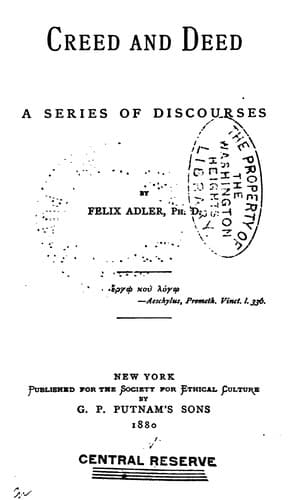
Creed and Deed: A Series of DiscoursesAdler, Felix
Religion
Creed and Deed: A Series of Discourses
Adler, Felix
Ethical culture movement; Ethics; Religion
But let us seek to scrutinize the distinctive features of the old and
new more closely. The old ideal was supernatural in character, it taught
man to regard his life on earth as a brief, temporary transit, himself
an exile from the Kingdom on high. The concerns of the present world
were in consequence deemed of secondary importance, and the eye dwelt
with anxious preference on the dim chances of the hereafter. Where the
hope of immortality has been prominently put forward by any religion,
the effect has thus but too often proved disastrous to the progress and
security of society. It is well-known by what painful penances the monks
of the Middle Ages sought release from the trammels of the flesh,
how they affected to despise the ties of domestic affection, how they
retarded the advancement of knowledge, how the passions which they
sought in vain to suppress often recoiled upon them with fearful
retribution, and gave rise to disorders which seriously undermined
public virtue.
But not only has supernaturalism tended indirectly to weaken the springs
of virtue, it has called into being an order of men whose very existence
is a standing menace to the freedom of intellect and the rights of
conscience. The distance between the Creator and his creatures is so
great, that the intervention of some third party is deemed necessary
to mediate between the finite and the Infinite. The priest steps in to
perform this office, and his influence is great in proportion to the
value of the services which he is supposed to render. Furthermore it
is believed that the personal deity requires the performance of certain
actions in his honor, and what these actions are is again left to the
priest to determine. In this manner the ceremonial part of religion
grows up, and acquires a degree of importance fatal to the moral life.
The duties toward God transcend the duties toward man, and but too often
usurp their place.
The Bible likens the relations of man to God to those of a child to its
father. It is true supernaturalism has often proved a valuable stay to
those already morally strong, and it were absurd to deny that under its
fostering care many of the noblest qualities that distinguish the filial
relation have been developed in the lives of religious men. It is from
no lack of appreciation on our part that we have dwelt on the evils
rather than the blessings it has brought. But in acknowledging that we
have really lost the sense of protection, the childlike trust which lend
such rare beauty to the character of many ancient models of piety, we
deemed it important to point to the shades that darken the picture
of the * supernatural religions, its lights are made the theme of a
thousand discourses week after week, and are hardly in any danger of
being speedily forgotten.
Public-domain text, read in full here on John Shaqi.
Reviews
Reviews
No reviews yet
Be the first to share your thoughts on this work.
Join the Discussion
Join the discussion
Sign in to leave a comment or review.
Sign InorCreate an account