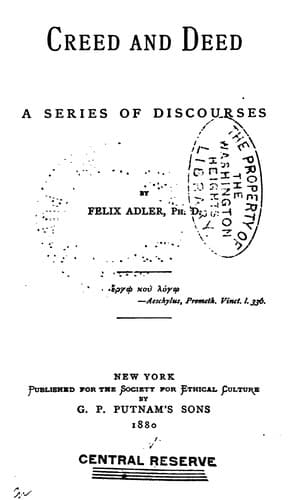
Creed and Deed: A Series of DiscoursesAdler, Felix
Religion
Creed and Deed: A Series of Discourses
Adler, Felix
Ethical culture movement; Ethics; Religion
Against all these forms of petition the modern view of life emphatically
protests. It starts with the grandest of scientific generalizations,
that of the universality of nature's laws. These laws cannot be broken;
they govern the course of the planets as they revolve through space,
they appear in the slightest eddy of dust that rises on our streets. The
world is a Kosmos; to pray for a change in its arrangements is to pray
for its destruction. The rains come when they must come, and the earth
yields or withholds her crop, as a system of causes determined from
immeasurable aeons of time prescribes. Is the God to whom men pray
so poor a workman that he will change the mechanism of the Universe at
their bidding? If all that is, is his work, why then the drought is
his work, and the famine, and the sickness are his work, and they are,
because he has willed that they should be. "The gods help them that
help themselves." We are placed in a world with which we are but half
acquainted; our business is to know it thoroughly. All the history of
mankind from the beginning has been a series of tentative struggles to
acquire this precious knowledge, and we have made indeed some headway.
We began by defending ourselves against the attacks of wild beasts; we
tilled the soil; we invented tools, we formed communities, we moderated
the friction of social intercourse; we discovered the talisman of
science, and the Aladdin's lamp of art. In the treatment of disease also
a great advance has been made. When the Mayflower reached the American
continent, she found a bleak and barren shore, full only of graves. A
great epidemic had swept over the Indian tribes, and the natives fell
like dead flies before the scourge. They had charms and prayers; these
did not help them. We have accomplished a little; we are bound to aim
at more. Why then call in the supernatural? It will not come, though we
call never so loudly. The vain attempt does but keep us from that which
is more needful, active exertion and strenuous efforts at self-help.
But we are told that our success is poor at best, and that in the vast
majority of cases, all our exertions avail nothing: moreover it is said
that man is too frail and feeble a creature to depend upon himself alone
in times of trial, and that prayer, whether it be answered or not, is
valuable as a means of consolation that soothes and stills the heart. It
is but too true that our achievements fall far short of our desires. Let
those that do not, cannot pray, seek support in the sympathies of
their kind, and where self-help fails, mutual help will offer them an
inexhaustible source of strength and comfort. As for that species of
prayer which is not addressed to a personal God at all, but claims to
be an aspiration, an outpouring of the spirit, we do fail to see how it
deserves the name of prayer in any sense. The use of the vocative,
and of the pronoun thou is certainly calculated to mislead, and the
Public-domain text, read in full here on John Shaqi.
Reviews
Reviews
No reviews yet
Be the first to share your thoughts on this work.
Join the Discussion
Join the discussion
Sign in to leave a comment or review.
Sign InorCreate an account