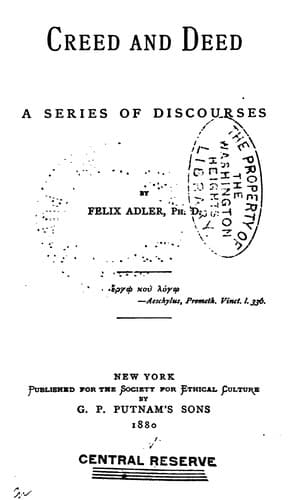
Creed and Deed: A Series of DiscoursesAdler, Felix
Religion
Creed and Deed: A Series of Discourses
Adler, Felix
Ethical culture movement; Ethics; Religion
The view we have taken of the origin of the conception of soul is
greatly strengthened when we consider the thoroughly material character
of the ghost's life after death. The ghost continues to be liable to
hunger, pain, cold, as before. But the living have shut it out from
their communion; in consequence it hates its former companions,
persecutes them where it can, and wreaks its vengeance upon them when
they are least prepared to resist it. In a certain district of Germany
it was believed that the dead person, when troubled by the pangs of
hunger, begins by gnawing its shroud until that is completely devoured,
then rising from the grave, it stalks through the village and in the
shape of a vampire, sits upon the children in their cradles, and sucks
their blood. When sated with the hideous feast, it returns to the
churchyard to renew its visits on the succeeding nights. In order to
hinder them from using their jaws, it was customary to place stones or
coins into the mouths of the dead before burial and the most grotesque
devices were resorted to, to prevent the much dreaded return of the
denizens of the tomb. In the middle ages the corpse was often spiked
down to hinder its rising. Among the Hottentots a hole was broken into
the wall, through which the corpse was carried from the house, and then
carefully covered up, it being the prevailing superstition, that the
dead can only reenter by the same way in which they have previously made
their exit. Among a certain negro tribe of Africa, the path from the
house to the grave was strewn with thorns, in the hope that the ghost
would find the path too painful, and desist. As late as 1861, it
occurred in a village in Gallicia, that the ghost of a dead peasant was
found to pursue the living, and the inhabitants rushing out to the grave
fearfully mutilated the body, to prevent it from committing further
injury.
Public-domain text, read in full here on John Shaqi.
Reviews
Reviews
No reviews yet
Be the first to share your thoughts on this work.
Join the Discussion
Join the discussion
Sign in to leave a comment or review.
Sign InorCreate an account