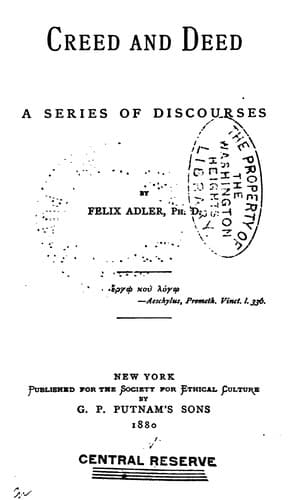
Creed and Deed: A Series of DiscoursesAdler, Felix
Religion
Creed and Deed: A Series of Discourses
Adler, Felix
Ethical culture movement; Ethics; Religion
Against the blows of misfortune also reason steels us. Sorrow is but the
lurking suspicion that all might have been otherwise. When we come to
know that all things are by necessity, we shall find tranquillity in
yielding to the inevitable. For so God works by necessity. For all
things are in his hands as clay in the hand of the potter, which the
potter taketh and fashioneth therefrom vessels of diverse value, some
to honor and some to disgrace. And none shall rebuke him, for all is by
necessity.
When the body passes away the mind does not wholly perish, but something
remains that is infinite, an eternal modus dwelling in the depths of
the eternal mind. But though we knew not that something of the mind
remained, yet were goodness and strength of soul to be sought for above
all else. For who, foreseeing that he cannot always feed on healthy
nourishment, would therefore sate himself with deadly poison? or who,
though he knew that the mind is not immortal, would therefore lead an
empty life, devoid of reason's good and guidance? The wisdom of the wise
and the freedom of the free is not in the aspect of death but of life.
Religion and piety lead us to follow the laws of necessity in the world
where they are manifest, to dwell on the intellect of God, of God their
fount and origin.
But I forbear to enter farther into this wonderful system. We see a
giant wrestling with nature, seeking to wrest from her her secret.
Mysterious nature baffles him and the riddle is still unread. That
substance of which he speaks is no more than an abstraction of the mind
whose reality in the outward world he has failed to prove. He has also
erred in turning aside from the rich and manifold life of the emotions,
for the emotions are not in themselves evil, they are the seminal
principle of all virtue.
On pillars of intellect, Spinoza reared his system. Still, solemn,
sublime like high mountains it towers upward, but is devoid of color and
warmth, and even the momentary glow that now and then starts up in his
writings, passes quickly away like the flush of evening that reddens the
snowy summits of Alpine ranges.
Spinoza's name marks a lofty peak in human history. He was a true man;
no man more fully lived his teachings. If he describes the pursuit
of knowledge as the highest virtue, he was himself a noble example of
tireless devotion in that pursuit. He was well versed in the natural
sciences, skillful in the use of the microscope, and his contributions
to the study of the inner life of man have earned him lasting
recognition. Johannes Mueller, the distinguished physiologist, has
included the third division of Spinoza's _Ethics_ in his well known work
on physiology.
Public-domain text, read in full here on John Shaqi.
Reviews
Reviews
No reviews yet
Be the first to share your thoughts on this work.
Elsewhere in the archive
Join the Discussion
Join the discussion
Sign in to leave a comment or review.
Sign InorCreate an account